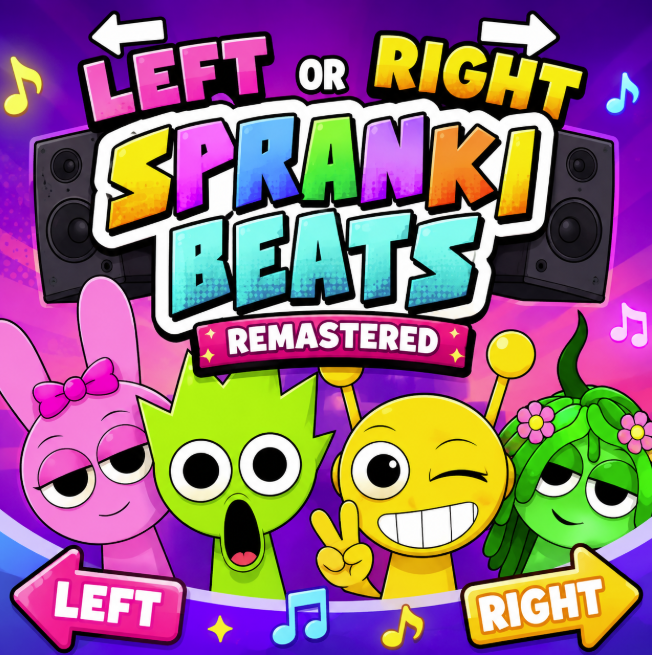
Left Or Right Spranki Beats
New Recommended Games




















Left or Right: Spranki Beats is an inventive rhythm game that distills the genre to its purest essence: a binary choice between two directions, synchronized with a musical pulse. Unlike conventional titles that demand complex button combinations, scrolling note highways, or dense visual feedback, this game strips the experience down to a single, elegant question—will your next move be left or right? The result is an engaging hybrid of reflex testing, pattern recognition, and auditory perception, delivering the thrill of a rhythm action game without entangled controls or overloaded interfaces.
The premise is simple: as music plays, the game issues prompts indicating which side of the screen to select. In its most basic form, the player must choose the correct side to match the cue. Timed with the accompanying track, each attempt maintains rhythmic consistency and builds a sensorial link between what you hear and what you do. The design ethos is accessibility—anyone can pick it up and understand the core loop within seconds—but the escalating speed and dynamic patterns ensure that seasoned players are not left with a shallow experience. Each track contains its own embedded rhythm signature, requiring the player to internalize the beat and predict the next prompt. The later tracks and advanced modes demand superior reactions, rhythmic intuition, and the ability to remain composed under tempo pressure. With a clear, intuitive user interface, visually unambiguous signals, and a compulsion loop that roars within minutes, Left or Right: Spranki Beats is a title that respects both newcomers and hardcore leaners within the niche, becoming an instant recommendation to rhythm game enthusiasts looking for a fresh twist on reflex-based gaming.
To get the most out of Left or Right: Spranki Beats, implement the following pratiche suggestions handed down from rhythm veterans:
Left or Right: Spranki Beats is an engaging meta-rhythm game that combines stark minimalism with robust depth. It honors the core principles of rhythm gameplay—practicing timing, memorization, and anticipation, and it wraps them in a simple two-digit access. For pros, more advanced modes provide a true benchmark of their reflexes, and for new players the onset and tutorials are a welcoming introduction. The real joyhere is in that small moment when the beat and your choice align flawlessly. So pick a side, focus, and let the music guide you.
Now check if we include all sections. "Précautions/Tips" spelling? We must use exactly "Precautions/Tips". In the summary, "How to Play" etc. We'll adjust if header case.
Also, the content mentions "rythm" but we should use correct "rhythm". Our article is in English.
We need about 1000 words. Let's count our draft. It's quite long; I'm not sure exact. I'll write more concise summary perhaps to balance. Let's estimate: Summary around 250 words, How to Play ~200, Key Features ~150, Tips ~300, closing ~100? Total ~1000. Good.
Now produce Markdown with headers as required. Ensure no extra preambles.
Let's final### Summary
Left or Right: Spranki Beats is an inventive rhythm game that distills the genre to its purest essence: a binary choice between two sides, synchronized with a musical pulse. Unlike conventional rhythm titles that rely on dense note highways, complex button combinations, or scrolling sliders, this game strips away all extraneous systems and leaves only the fundamental challenge—do you choose left or right, and can you do it exactly on the beat? The result is a seamless hybrid of timing, pattern recognition, and auditory intuition that offers a refreshingly accessible entry point for newcomers while still providing a substantial test for seasoned players.
The core premise is elegantly simple: prompts appear on screen indicating a left or right position, and the player must select the corresponding side in tune with the rhythm of a given track. Each track is built around its own rhythmic structure, requiring the player to internalize temporal spacing and anticipate when the next cue will arrive. The early tracks act as a gentle tutorial, encouraging players to grasp the basic flow. As the player advances, the speed increases, the patterns become more irregular, and the greater accuracy becomes mandatory. What sets this title apart, aside from its purity, is the speed at which it escalates—within the first hour, the game transitions from a casual listen-and-tap pastime to a high-stakes test of auditory processing and micro-decision accuracy. The vibe is intuitive for novices but deeply rewarding for those wanting to measure rhythm. Ultimately, Left or Right: Spranki Beats strips away all noise and entrusts you with a core primal wonder: can you be on the beat?
When you step into the game, you are greeted by a clean interface with a minimal selection of songs. Begin with an easier track to become comfortable with the rhythm and control. The playable is incredibly straightforward: during the song, you will see cues appear that guide you to choose the left or right side. Your task is to press the corresponding button or touch the appropriate area just as the beat hits. The crucial element is not how quickly you react, but how accurately you land each selection in tempo. Instead of smashing the input as fast as possible, you must listen to the beat and "slot" your move inside the groove.
Each song uses directional sounds, visual flashes, or pan effects to inform which side to pick. The base mode combines visual arrows and musical accents. A slow, steady tempo helps teach the fundaments; later songs feature more complex offbeat patterns that will break your anticipation. To play well, you need to develop both your peripheral vision and your sense of pulse. One useful method is to mentally "silence" the visual cue and rely on the rhythmic grooves for your hints. This is especially important because the game features four distinct modes, each with a unique rule on the classic left/right selection:
Each mode has its own skill curve, and players can switch between them to train different aspects of perception. Use the early tracks as pure training; do not rush to hardest difficulty, as you need to build your internal beatmap.
Successful play is not just about how quick you click—others have to be careful about the whole rhythm experience. Here are several tips to improve performance and avoid common pitfalls:
To sum up, remember: precision over raw speed, solid hearing, spatial awareness, and clear mental maps. Left or Right : Spranki Beats is a celebration of minimal groove. The player is invited to enter a musical loop where their input becomes the beat. It's the whole what – feel of sensorial gratification and sound added. That's the summit to master: not just be able to choose, but to choose in complete humanity to tune.
A: Left Or Right Spranki Beats is a rhythm-based game that blends engaging melodies, fast reflexes, and straightforward directional decisions. As the music plays, you observe on-screen cues and pick the appropriate side at the precise moment.
A: The central goal is to pick either the left or right side based on the cues displayed, ensuring your selection lands in sync with the musical beat.
A: Not at all. There are no intricate control schemes involved; your only tasks are to listen to the soundtrack, keep an eye out for the cues, and choose the correct direction.
A: Absolutely. The core mechanics are simple enough for newcomers to grasp quickly, and the introductory tracks are specifically designed to familiarize players with how the game works.
A: Yes, it does. The tempo of the patterns gradually accelerates, and the later tracks demand quicker reflexes along with a more refined sense of timing and rhythm.
A: The game includes four distinct gameplay modes. Depending on which mode you choose, you might need to respond to musical rhythms, react to audio cues, follow visual indicators, or adapt to shifting pattern structures.
A: Every mode introduces its own variation on the fundamental left/right selection mechanic, keeping the experience fresh and engaging. Some modes emphasize musical timing, others focus on sound-based reactions, some rely on visual signals, and a few combine these elements with changing patterns.
A: Beginners should start with a slower track and focus on the upcoming cues. When the game signals left, move to the left side; when it signals right, move to the right side. Aim to make each move exactly in time with the rhythm.
A: If a sequence starts to feel overwhelming, take a mental step back and focus on handling just one cue at a time rather than trying to process the entire pattern at once.
A: Precise timing matters far more than sheer speed. Pay close attention to the music so you can predict when the next directional choice will appear and react accordingly.
A: Keep your gaze fixed near the area where the cues show up, minimize any unnecessary hand or body movements, and replay tracks regularly so you can learn common rhythmic patterns and respond more instinctively.
A: Once you feel comfortable with the fundamental patterns, challenge yourself by moving on to faster songs and more demanding modes that push your reaction time and rhythmic accuracy.
A: The learning curve is both enjoyable and satisfying, featuring simple controls that are easy to learn, a variety of modes to explore, and tracks that grow progressively harder to keep you challenged.
A: This game is an excellent fit for rhythm enthusiasts who appreciate a creative twist on the traditional rhythm-game formula and enjoy testing their timing and decision-making skills.
Upon launching Left Or Right Spranki Beats, players are presented with a variety of tracks. For newcomers, starting with a simpler track is advised in order to grasp the core rhythm and understand how prompts evolve. The mechanics are straightforward: cues show up, telling you whether to pick the left or right side. You then respond by tapping or pressing the key that matches that side. Timing is everything—your input needs to align with the beat's rhythm, rather than relying solely on remembering the order.
The initial stage functions as an interactive tutorial, progressively introducing more prompts and setting the tempo. Beginners should focus on the display area and wait for the visual signal to appear. Simultaneously, pay attention to the music and try to sync your response with the beat. Randomly clicking as fast as possible will lower your score; the game penalizes careless button mashing. Rather, precision timing is valued more than raw speed. Across all modes, the core principle stays constant—choose left or right whenever a cue appears—yet the form of that cue can vary significantly.
The Four Modes:
Left or Right (Classic) – This is the base mode. Cues are shown as arrows or text reading “LEFT” and “RIGHT.” The music and visual indicator arrive at the same time, providing two simultaneous signals that help you quickly build a connection.
Sound-Only Mode – Here, all direct visual cues are stripped away. Instead, you listen for a unique audio signal—such as a sound panned sharply to the left or right, or a musical note emerging from a particular channel. Your task is to identify the source side and respond without delay. This mode sharpens your listening skills and challenges your reaction speed.
Visual Prompt Mode – This mode removes musical guidance and relies solely on visual indicators, such as a flash of color or an object moving on one side. It requires almost subconscious processing, and the difficulty ramps up as the speed increases.
Pattern Shift Mode – This mode combines elements from the others. Auditory and visual signals may still be present, but the crucial twist is that the rules can change during a track—for instance, you might suddenly need to select the opposite side, or the left/right orientation could be reversed. Players must constantly stay alert to the evolving conditions.
Every mode keeps the apparent simplicity of choosing left or right, yet each one changes the level of mental effort required. Regularly moving between them trains the brain to make sharp distinctions.