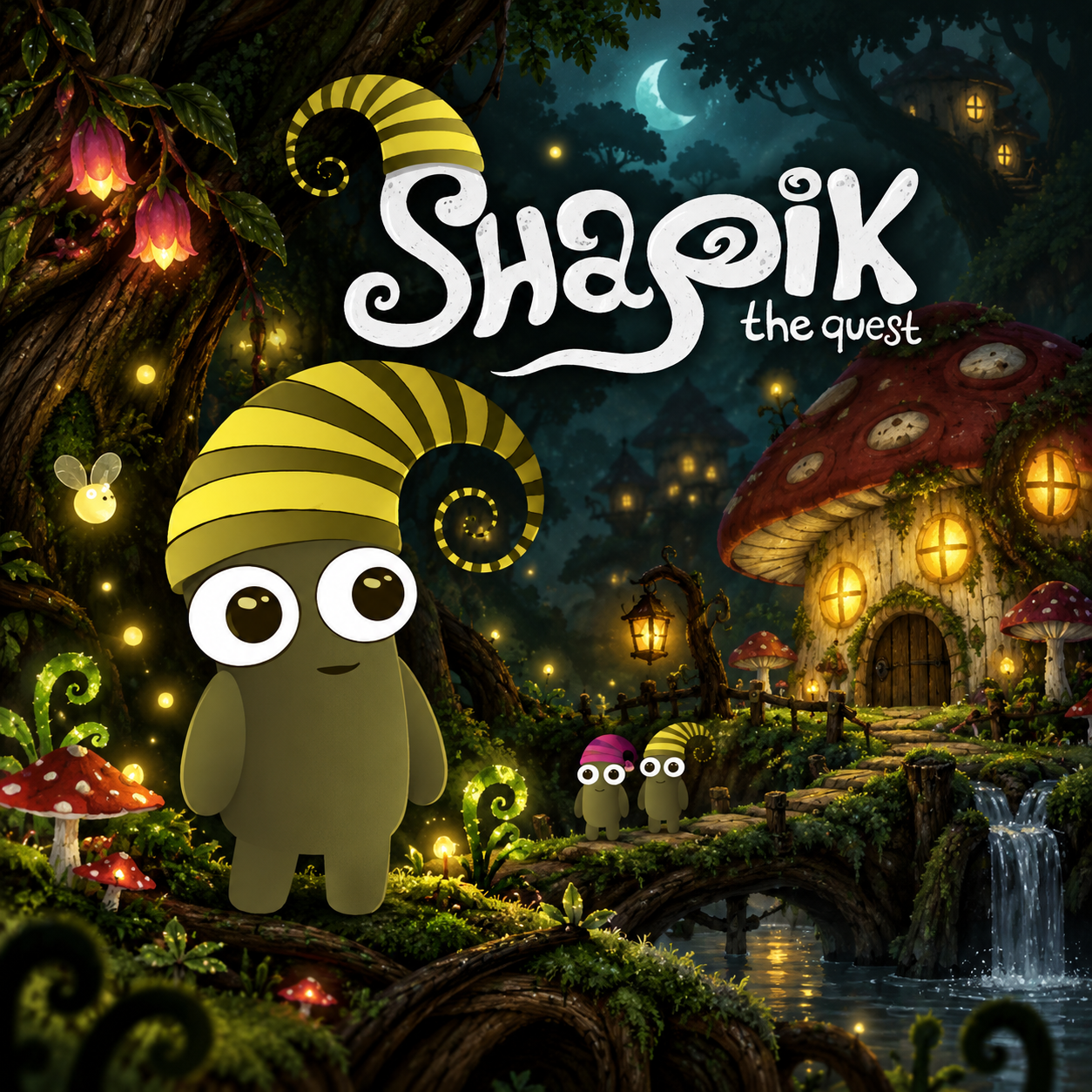
Shapik The Quest
New Recommended Games














Shapik: The Quest is a meticulously designed click-based adventure game that casts players as a tiny, resolute hero embarking on a touching journey to locate his lost sister. With a devoted and clever bee by his side, Shapik explores a charming hand-illustrated realm filled with unusual beings, ancient devices, and carefully concealed objects. What sets this title apart is its dedication to visual narration: there are no long conversations or text-heavy instructions. Instead, the plot unfolds through expressive animations, delicate character movements, color palettes, and symbolic elements within the environment. This design choice keeps the experience approachable and absorbing, enabling players to piece together the storyline and grasp their goals through careful observation and natural curiosity.
The browser edition of Shapik The Quest includes nine separate stages, each offering a distinct challenge that demands more than mere cursor clicks. Players must clear obstructed routes, restore broken equipment, aid eccentric inhabitants, and alter their surroundings to move forward. Every stage functions as an independent puzzle environment, promoting thorough exploration and thoughtful reasoning. The tranquil mood, along with the complete absence of time constraints, makes Shapik: The Quest a perfect choice for those who appreciate contemplative, atmospheric gameplay rather than frantic, reflex-driven entertainment.
Shapik: The Quest is notable for its unique artistic style and refined execution. The hand-drawn backdrops are full of character, with every level possessing its own distinct ambiance. Dense vegetation, swaying wooden bridges, odd mechanical contraptions, and whimsical animals are not simple decorative elements; they are essential components of the puzzle mechanics. This seamless integration of artwork and gameplay results in a world that feels vibrant and meaningful.
The storytelling method is another outstanding aspect. By deciding to convey the narrative without spoken or written dialogue, the creators have crafted an experience that crosses language barriers and lets players concentrate on visual interpretation. The lack of text imparts a calm, enigmatic tone to the journey, while the expressive character animations preserve the emotional bond between the player, Shapik, and his mission.
The musical score adds another layer of immersion. Gentle, melodic tunes accompany the player during the entire adventure, reinforcing the unhurried rhythm of the game. There is no countdown, no losing condition, and no incentive to hurry. This relaxed environment encourages players to linger in each scene, examine every detail, and slowly unlock the reasoning behind each puzzle. The game trusts the player’s intellect and values attentive observation over quick reactions.
Regarding controls, the game is refreshingly uncomplicated. A single left mouse button handles nearly every action, including movement, examination, selection, and interaction. This minimal control layout makes the title accessible to beginners while still offering sufficient depth to engage veteran adventure enthusiasts. Touchscreen compatibility also guarantees a smooth transition between desktop and mobile devices, preserving the same intuitive feel across different platforms.
For those just starting out, several useful pieces of advice can greatly improve the experience and help avoid unnecessary frustration. First, avoid the temptation to click randomly. Shapik The Quest is a puzzle-driven adventure, and every object has a purpose. Haphazard clicking might occasionally uncover a hidden item, but it is much more productive to stop, study the scene, and think about how the various components might connect with one another.
Keeping an eye on the bee is absolutely vital. If Shapik cannot reach a certain area or a puzzle appears unsolvable from his current spot, the bee is almost certainly an essential part of the answer. Be sure to inspect the upper portions of the screen as well, since many key objects and triggers are positioned above ground level specifically to require the bee’s help.
Another useful habit is to observe the environment carefully after every action. The game signals progress through subtle visual cues. A character’s facial expression may change, a small gear might turn, a lamp could illuminate, or a faint noise might be heard in the distance. These clues are not accidental; they are the game’s method of steering the player toward the next logical step. By remaining attentive, players can often resolve puzzles without ever feeling confused.
Finally, always remember that there is no deadline. The greatest asset of Shapik: The Quest is its leisurely tempo. Do not hurry through the stages. Take a moment to appreciate the hand-drawn artwork, enjoy the soothing soundtrack, and fully immerse yourself in the atmosphere. A patient and observant mindset will always be rewarded in this charming and captivating adventure.
A: Shapik: The Quest is a click-based adventure game centered on a tiny hero in search of his lost sister. With a trusty bee at his side, Shapik journeys through an enchanted world populated by strange beings, concealed items, and intricate mechanical challenges.
A: The central narrative revolves around Shapik, a diminutive hero on a quest to locate his vanished sister. Throughout his journey, he is joined by a supportive bee while traversing a fantastical landscape.
A: Rather than relying on lengthy dialogue, the narrative is delivered through animations, facial expressions, and visual cues. This approach keeps the adventure accessible while maintaining an air of enigma.
A: The browser edition offers a total of nine levels.
A: Every area presents a unique obstacle, whether it involves clearing a blocked route, fixing a device, or assisting an inhabitant.
A: The left mouse button is used for moving, examining items, choosing characters, and resolving puzzles. On compatible touchscreens, tapping performs the same actions.
A: Select a spot to make Shapik walk there, then interact with nearby objects and characters. The majority of puzzles demand a sequence of linked steps.
A: The bee is able to access locations that are too elevated or distant for Shapik. Whenever the hero is unable to manage a task by himself, check for items positioned above ground level.
A: Refrain from random clicking. Begin by spotting the interactive elements, then think about how they could be connected. You might have to locate an object, determine its proper place, and trigger a device before the route becomes accessible.
A: Hints are frequently embedded in the environment, character movements, color schemes, or symbolic details. Observe any changes following each action, since even a minor animation can indicate the next move.
A: Because even a subtle animation can reveal the subsequent step, carefully watching the environment after each move helps clarify what needs to be done.
A: The hand-crafted visuals grant each stage its own character. Vegetation, walkways, machinery, and odd creatures are more than mere decoration—they frequently play an integral role in the puzzles.
A: No. It employs a dialogue-free narrative approach, communicating the plot through animations, facial expressions, and visual imagery.
A: The soothing soundtrack and wordless storytelling produce a tranquil rhythm. Since there is no pressure to hurry, you can take your time investigating every area and deciphering its hints.
A: No. Although plants, bridges, machines, and peculiar creatures may initially appear ornamental, they are often essential components of the puzzle.
The fundamental gameplay systems of Shapik: The Quest are easy to understand, yet they demand a tactical approach to truly excel. Initially, the player employs the primary mouse button to select a point and guide Shapik across the scene. After reaching the desired spot, the identical click action allows for manipulating objects, examining inventory pieces, and communicating with the diverse characters positioned across the environment. On compatible touch-enabled gadgets, a simple tap fulfills the same role, guaranteeing that the title operates seamlessly on tablets and smartphones.
The riddles presented in the game are seldom resolved through one isolated move. Instead, the majority call for a chain of linked actions. A common resolution could entail discovering a crucial object in one zone, determining the proper place for that object in a different section of the setting, and subsequently triggering a device that ultimately clears the route ahead. Such a connected structure encourages perseverance and close attention to detail.
A particularly vital gameplay feature involves working together with the bee ally. This insect is far more than a simple visual addition; it serves as a critical instrument for advancing through the adventure. Numerous locations remain completely inaccessible to Shapik because of their elevation or remoteness. Whenever the protagonist seems incapable of finishing a job by himself, the player ought to glance upward and evaluate whether the bee might reach an elevated platform, activate a far-off switch, or collect an item situated in an otherwise unreachable area. Deciding the right moment to alternate between directing Shapik and employing the bee constitutes a fundamental element of overcoming the game's obstacles.
Environmental hints represent yet another essential dimension of the gameplay. The title seldom offers explicit guidance, forcing players to interpret the surroundings carefully. Such hints can manifest through the layout of the landscape, the way a character looks in a certain direction, an item marked with a specific color, or a glyph carved onto a surface. Observing the results of each move is crucial, because even a slight alteration in animation or a faint audio signal may reveal that forward movement has occurred or that a fresh possibility has emerged.
Most importantly, gamers ought to refrain from indiscriminately pressing buttons across the display. Rather, the optimal strategy involves initially recognizing every interactive element present in a given scene, then reflecting on how those elements could sensibly combine. By devising a well-defined strategy prior to taking action, resolving the game's riddles turns out to be considerably more rewarding and productive.