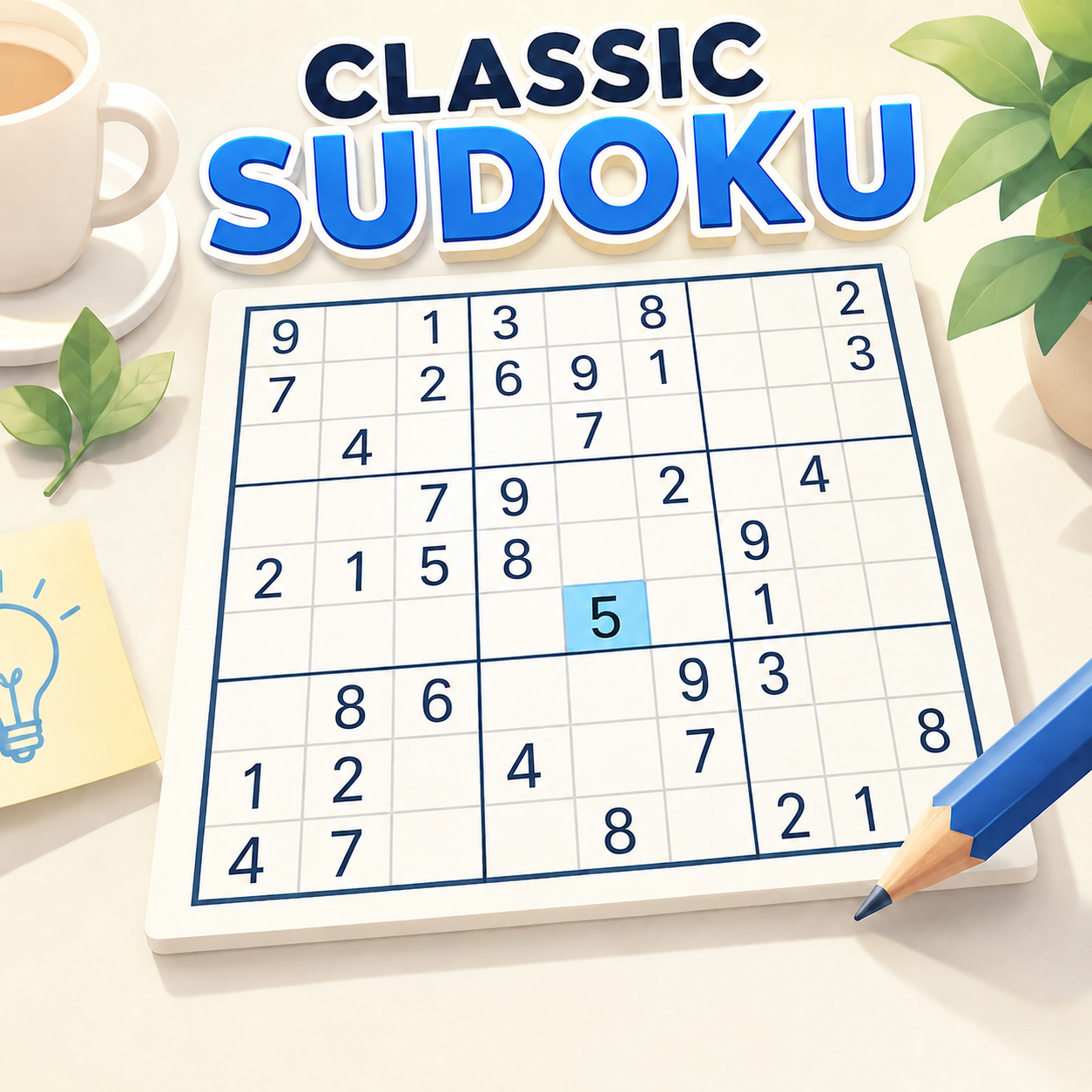
Classic Sudoku Puzzle
New Recommended Games


























Classic Sudoku Puzzle stands as a meticulously designed digital rendition of the enduring number-placement logic game that has engaged puzzle lovers across generations. Each challenge presents a conventional 9x9 grid, partitioned into nine distinct 3x3 sub-grids. At the start, a selection of cells is already occupied by predetermined digits. The objective remains elegantly simple: complete every vacant cell so that the numbers 1 through 9 appear precisely once in each horizontal row, each vertical column, and each 3x3 block. No mathematical calculations are required; Sudoku is purely an exercise in deductive reasoning, careful observation, and recognizing patterns. The experience depends neither on luck nor on quick reflexes, but rather on the methodical identification of constraints. For newcomers, the interface provides clear visual cues that emphasize connected rows, columns, and boxes. For seasoned players, the core mechanics remain untouched, offering the same deep concentration and strategic fulfillment found in the traditional version. Whether operated with a mouse on a desktop system or through touch gestures on a mobile screen, this digital adaptation preserves the essence of the original concept and provides a tidy, uninterrupted experience suited equally to casual players and devoted enthusiasts.
Classic Sudoku Puzzle incorporates a variety of considerate features aimed at maximizing clarity while staying true to conventional Sudoku logic. The traditional 9x9 grid, separated into nine well-defined 3x3 sections, maintains the expected visual layout. When a cell is selected, the interface emphasizes all related regions and numerical associations, offering direct visual support. The candidate Notes system is included as an essential tool, allowing players to track uncertain possibilities without committing to a permanent entry. The straightforward undo, erase, and hint functions make correcting missteps and reversing prior actions effortless. A five-error limit counter adds transparency and reinforces the importance of careful, deliberate reasoning. A timer operates throughout the entire session, recording elapsed time and helping players improve their solving speed across repeated attempts. Controls are adapted to the platform: desktop users interact with a simple mouse, while mobile users rely on touch input. Together, these elements create a focused, well-structured Sudoku experience that honors the classic format.
As you work toward a flawless solution, keep a few essential points in mind. The game generally permits no more than five mistakes across the entire puzzle. Consequently, random guessing is not a viable approach. Rather than hastily inserting an arbitrary number, examine the adjacent row or block and consider where numbers can be placed without conflict. The process of elimination provides a smooth path forward. Make good use of the Notes system, but keep it updated. Once a number is confirmed within a group, remove any leftover candidate notes in the same row or block that are no longer possible. Incorrect entries made earlier will not clear themselves automatically. Avoid relying too heavily on the hint feature; it can provide the correct answer when you are truly stuck, but using it before exhausting all logical possibilities diminishes the satisfaction of solving the puzzle. Always verify that every digit you enter satisfies all three conditions simultaneously: no duplicate in the row, no duplicate in the column, and no duplicate in the box. Overlooking a single row after confirming only the column is a common oversight.
Regardless of difficulty level, begin by resolving the simplest cases, such as single candidates and intersection-based deductions, before moving on to more intricate sequences. Careful pairing and comparison are advisable; repeatedly scanning the board will eventually make the missing value obvious. Treat the visual highlights as a reliable guide to confirm your choices. As a bonus, the more efficiently you solve, the faster the timer will reflect your progress, allowing you to refine your technique. Thinking of leaving mid-solution? The game does not clearly indicate whether progress is saved, so it is wise to finish the puzzle before exiting, if only for the sake of completeness. Remember this: Sudoku is as much a test of patience as of logic; steady, disciplined persistence leads to a clean victory.
Finally, if you find yourself stuck near the end, revisit every subsection until you locate a single empty cell. You should always be eliminating possibilities, never guessing. The next number can almost always be found elsewhere on the grid through careful observation. That quiet scrutiny, thoughtful evaluation of potential conflicts, repeated placement, and timely use of the chosen digit form the essence of a perfect solve. Take time to become familiar with the interface and keyboard controls. Then focus your attention: this is an excellent exercise for the mind, and this adaptation does full justice to the timeless pastime.
A: The objective is to complete all blank squares in a 9x9 grid, ensuring that every horizontal line, vertical line, and 3x3 block contains the digits 1 through 9 exactly once, with no repeats.
A: The playing field consists of nine distinct 3x3 sub-grids. At the beginning, a set of numbers is already provided as clues, and the player must fill in the remaining empty positions.
A: A number is considered valid only if it does not already occur in the same row, the same column, or the same 3x3 box as the target cell.
A: The game enforces a maximum of five mistakes. Each wrong entry raises the Mistakes counter, and going beyond that limit can put your current attempt at risk.
A: Yes, an integrated timer tracks the duration of your solving session. This allows you to compare your completion times and monitor your progress as you become more proficient.
A: The Notes function enables you to jot down possible candidate numbers inside a cell without committing to them as final answers. This is especially helpful when two or three digits are still plausible, and you can gradually remove candidates as neighboring cells are solved.
A: The interface includes number buttons from 1 to 9 for entering digits, Undo to revert your most recent action, Erase to delete a number you have placed, Notes for recording candidates, and Hint for receiving guidance.
A: The Hint tool offers assistance whenever you are unable to determine the next logical move on your own.
A: On a desktop computer, you can use the mouse to select cells and click interface buttons. On a mobile device, simply tap the desired cells and numbers directly on the touchscreen.
A: When a row, column, or 3x3 box is missing just one digit, you can deduce that digit by looking at the numbers already present. For more difficult situations, examine which numbers are ruled out by all three intersecting areas around a cell; if only one digit remains possible, that digit can be placed with confidence.
A: Instead of making a random guess, shift your attention to another section of the board. Completing a cell elsewhere may remove a candidate and uncover the next logical step.
A: The currently selected row, column, and related cells are visually highlighted, which makes it simpler to compare numbers and spot conflicts across the entire grid.
A: Absolutely. The Undo tool cancels your latest action, while the Erase tool removes a digit that you have previously entered into a cell.
A: Sudoku relies on logical elimination rather than arithmetic. Begin by focusing on rows, columns, or 3x3 boxes that already contain many filled numbers, and search for forced digits. Use Notes for uncertain cells, and avoid resorting to random guessing.
A: The standout features include a standard 9x9 Sudoku grid, nine clearly separated 3x3 boxes, highlighted rows, columns, and related numbers, a candidate Notes system, Undo/Erase/Hint tools, a mistake counter, and a timer that records your solving time.
In a Classic Sudoku Puzzle, play opens with a conventional 9x9 grid populated by a prearranged collection of given digits. These initial numbers are not optional hints; they serve as the cornerstone from which every subsequent value must be deduced. To enter a number, select an empty cell and then pick a digit from 1 to 9 using the number palette positioned nearby. The game enforces the fundamental principle of Sudoku: any digit placed in the chosen cell cannot already exist in its row, column, or associated 3x3 block. The interface actively supports this process by illuminating the active row, column, and surrounding cells relative to the current selection, allowing the player to review all neighboring values before making a final decision.
Logic remains the essential instrument for solving. Rather than resorting to arbitrary guesses, a player should begin with the area that offers the greatest concentration of clues. The primary guideline is to examine rows, columns, or boxes that already contain the most filled digits. For instance, if a row contains 1, 2, 3, 4, 5, 7, 8, and 9, the single empty cell clearly calls for a 6. This straightforward deduction based on the missing final digit applies equally to any row, column, or block. The task becomes quite simple when only one cell is vacant, because such a conclusion cannot be erroneous. In regions that are less completely populated, however, the solver must employ a more extensive elimination process. For every candidate cell, inspect the digits appearing in its three intersecting sectors: the shared row, the shared column, and the shared 3x3 block. If, after reviewing all three zones, a number appears nowhere else and cannot fit into any of those constrained positions, confirm it as the correct entry.
When multiple possibilities remain across several cells, the game provides a notation feature. This enables the player to record possible values directly within a cell without finalizing the placement. These small annotations act as provisional memory aids, much like pencil annotations used on a physical Sudoku grid. This capability proves especially useful on more challenging boards. Suppose a particular cell could hold a 3, a 6, or a 9 under the current constraints. Instead of relying on memory, jot down those options. As other cells on the board are resolved, these candidates can be eliminated when the same digit is placed elsewhere in a relevant zone. The only reliable way to ensure the final cell is correct, as it should be, is to narrow the possibilities down to a single remaining candidate.
If the player reaches a point of stagnation, the game offers a hint option that reveals a correct digit. In addition, the undo and clear commands allow a mistaken entry to be removed or an unwanted value to be corrected. Random selection has no legitimate role in this process: Sudoku solving is deterministic, and although a puzzle's uniqueness may not always be guaranteed, guessing will sooner or later affect the mistake counter. Because the board permits only five errors before the run is placed in jeopardy, careful and deliberate logical moves are essential. Take advantage of the available highlight cues, depend on the notes to keep track of possibilities, and allow the layout to direct each placement. Once the final cell has been correctly filled, the timer stops recording; the match is finished, and in time the player may attempt to achieve a faster completion in order to challenge oneself.