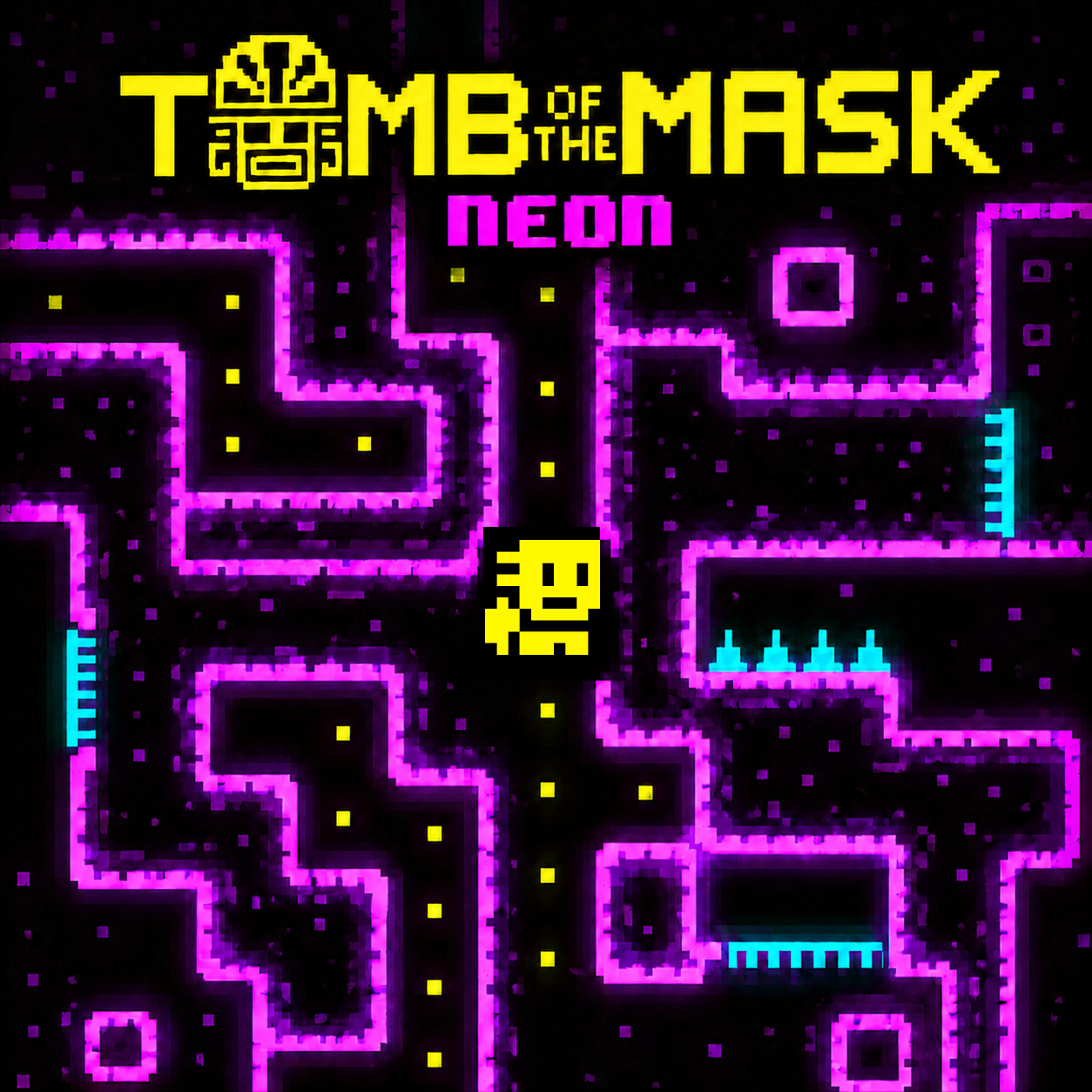
Tomb Of The Mask Neon
New Recommended Games

























Tomb Of The Mask Neon: A Thorough Overview
Tomb Of The Mask Neon delivers a high-energy arcade adventure that merges timeless maze exploration with contemporary neon visuals and exacting control demands. Players take on the identity of a masked adventurer ensnared within a network of luminous tunnels, where each corridor is adorned with shimmering dots, gleaming coins, twinkling stars, and a diverse assortment of deadly impediments. The primary goal is unambiguous: eliminate every dot from each stage and reach the escape hatch. Yet the journey to success is anything but straightforward. The game's locomotion engine relies on a one-of-a-kind dash feature, compelling participants to fully dedicate themselves to each directional command, thereby transforming every passageway into a conundrum of inertia, scheduling, and environmental awareness.
The title presents an organized sequence of 25 stages, each meticulously crafted to introduce novel dangers and progressively intricate arrangements. The initial levels emphasize fundamental movement and acquisition skills, whereas subsequent stages challenge players with animated adversaries, timed spike mechanisms, projectile launchers, and even relentless pursuers. Successfully navigating the standard missions unlocks a unique culminating test, offering a grueling finale for individuals who have fully grasped the game's underlying principles. Thanks to its crisp controls, brilliant pixel graphics, and steadily rising difficulty, Tomb Of The Mask Neon appeals to enthusiasts seeking short, skill-focused gaming sessions and deliberate path optimization.
Tomb Of The Mask Neon delivers a streamlined yet polished experience tailored for old-school arcade engagement. The 25-level campaign features a gentle escalation in challenge, each succeeding stage expanding upon the concepts established earlier. The final trial, accessible only after completing prior missions, serves as a worthwhile examination of every ability the player has acquired.
The hallmark attribute is the dash-based navigation system. By requiring the explorer to glide until collision with a barrier, the game elevates elementary directional buttons into strategic choices. This feature cultivates a distinctive balance between speed and restraint, gratifying those who can rapidly interpret a labyrinth and forecast multi-step trajectories in advance.
From a visual standpoint, the title adopts an illuminated pixel-art motif. The passageways are vivid, saturated, and remarkably legible, allowing immediate differentiation among dots, coins, stars, devices, and foes. The visual transparency proves indispensable because the gameplay necessitates swift assessment upon each new screen. Furthermore, this aesthetic grants the game a singular character, uniting classic arcade influences with a contemporary glow.
The assortment of hindrances constitutes another notable strength. Stationary blades, timed spike grids, wandering sentinels, projectile turrets, elevating lava, and relentless chasers guarantee no two stages feel repetitive. Each threat type demands a tailored response, and later environments frequently integrate several dangers within the same maze. This variety sustains engagement and fosters continuous strategic adaptation.
Unlockable cosmetic and functional items introduce a slight advancement element. As participants advance, masks become attainable, bestowing special properties that may aid in navigation or survival. Although these enhancements offer convenience, they never supersede the necessity for meticulous foresight. The fundamental challenge remains constant: comprehend the maze, sync with hazards, and execute each movement decisively.
The controls accommodate various platforms seamlessly. Whether operating via keyboard arrows or touchscreen swipes on mobile devices, the game ensures immediate, exact user input. Such adaptability allows short play sessions with ease, while the difficulty offers enough intricacy for prolonged involvement.
Achieving proficiency in Tomb Of The Mask Neon hinges less on split-second reflexes and more on methodical planning. Before initiating any direction, pause to consider where the explorer will terminate. A seemingly harmless passage may lead directly into a spiked trap or leave only unsafe alternatives for the following jump. Always envision a safe exit before deciding to dash.
Closely observe the timing of hostile elements. Repeating spike panels follow a consistent beat, and waiting for the correct moment is frequently wiser than impulsive sprints. Watch the cycle fully—if necessary, allow a complete loop. Patience is not a disadvantage here; it is a survival mechanism.
When harvesting dots, resist the urge to chase them sequentially. Instead, survey the entire level's structure and strategize the optimal route. Some collectibles are stationed in zones requiring a particular method of entry. Approaching a side corridor from the wrong angle may your doom, so plan each line of approach to avoid getting trapped.
Exercise vigilance when handling moving enemies and projectiles. These threats usually move in fixed patterns but can easily catch a careless player. Observe their movements from a secure standpoint before entering their territory. If a projectile emitter is active, pause until the trajectory clears before proceeding.
In zones with ascending lava or relentless pursuers, maintain constant movement but resist panic. The urgency to advance quickly often prompts hasty misjudgments. Leverage walls as safe breaks and anticipate two or three moves in advance. Occasionally, the optimal route is not the most direct; a longer deviation may offer more favorable timing.
Employ masks with special qualities wisely. Avoid relying on them to cover for inadequate planning. Use them as supports for specific circumstances, but persist in a strong comprehension of the maze topology and hazard sequences.
Above all, remember that any lethal obstruction instantly ends the run. If a level feels overwhelming, take a brief pause and study the screen before acting. The game rewards a measured, controlled approach. Speed will emerge naturally with increasing familiarity. The most successful players couple quick observation with disciplined choice-making, converting every wall into a springboard rather than a dead end.
A: Tomb Of The Mask Neon is a rapid-paced arcade experience that merges labyrinth navigation with exact timing requirements. You are placed in control of a masked adventurer, guiding them through colorful pixel-style corridors that contain glowing points, coins, stars, hostile creatures, and fatal traps.
A: On desktop or laptop systems, movement is handled using the arrow keys. If you are playing on a touchscreen, simply make a sliding gesture in any direction to send your character in that direction.
A: Rather than advancing one grid cell at a time, the avatar moves continuously along a corridor when a directional command is given. The explorer travels until they collide with a wall or another solid object. It is not possible to reduce speed or reverse direction while the movement is underway.
A: You have to gather every small yellow orb before you can finish the stage. Coins contribute to your total score, and stars provide a bonus for searching the stage thoroughly. In addition, you must also locate and reach the exit portal.
A: Tomb Of The Mask Neon consists of 25 stages, each step introducing more complicated layouts and a greater assortment of dangers. After successfully completing all earlier levels, a unique final challenge is unlocked as a reward.
A: The game offers three distinct types of collectibles: tiny yellow dots (these are mandatory for level completion), coins (which add to your score), and stars (which act as a reward for fully exploring every nook). These items are generally hidden in side alcoves or placed near hazardous elements to increase the risk.
A: The most basic threat you encounter is fixed spikes. As you progress, new dangers appear: spike tiles that extend and withdraw, enemy figures that move along set patrol routes, mechanisms that launch projectiles, and chasing dangers such as a gradual lava river that rises up.
A: Before every movement, you should pay attention to three pieces of information: the standard landing point where your character will halt, the current timing of any nearby trap or enemy, and the next potential safe direction that is available from that stopping point. Taking deliberate, measured actions than complying rapidly to press buttons is far more reliable.
A: Touching any type of deadly hazard instantly terminates your current run. Consequently, you have to restart the level from scratch.
A: Mask items that become available as you advance can grant you special powers. Even so, a careful and thoughtful path remains indispensable to success at all times.
A: Finish the initial 25 stages, and this will bring about the appearance of a special final challenge as a reward for your consistent clearances.
A: Every wall should be seen as a momentary pause for evaluation. Determine where the explorer will stop and assess whether there is still any safe path from that specific spot. A corridor might look safe, but it could easily lead you straight into a spike wall or leave you without any safe move next to continue.
A: Yes, the game supports touchscreen controls—simply swipe in whichever direction you need to move.
A: Tomb Of The Mask Neon falls under the arcade adventure category, centered on maze traversal, logical reasoning, and escape mechanics. It is commonly classified as a fast-paced arcade game that challenges you to act with precision and timing.
The mechanics are straightforward to grasp, yet they demand careful refinement. On a desktop setup, directional keys govern movement; on mobile devices, sliding your finger across the screen triggers the same response. There are no intricate button sequences or ability menus to worry about. The true difficulty emerges from comprehending how motion functions and leveraging that insight when the stakes are high.
In contrast to conventional maze titles that permit tile-by-tile navigation, Tomb Of The Mask Neon implements a rapid sliding mechanism. As soon as a direction is chosen, the character glides along the corridor until obstructed by a barrier or another solid object. Stopping mid-slide or altering course before that stopping point is wholly impossible. This singular principle dictates the entirety of the gameplay. Every wall acts as a provisional waypoint, necessitating advance planning of each subsequent action. Thus, before activating any direction, one must anticipate exactly where the explorer will halt, evaluate the safety of that zone, and determine whether a potential path of escape exists from that fresh position.
The ultimate objective within each stage involves collecting all small golden specks dispersed widely throughout the labyrinth. The stage remains incomplete until every speck is seized and the terminal point is accessed. Beyond these, monetary bonuses appear as supplementary rewards, and star icons incentivize deeper exploration. These pickups are frequently tucked away in recessed corridors, positioned behind bends, or adjacent to lethal mechanisms. Reaching them may entail approaching from an alternate trajectory, waiting for a threat to dissipate, or traversing a roundabout course before eventually nearing the end portal. Consequently, strategic path arrangement proves vital to avoid redundancy in traversal and minimize sustained vulnerability to hazards.
Dangers introduce an extra dimension of complexity. Mounted spikes present the initial serious menance, though later stages introduce periodic protracting and retracting hazard tiles alongside patterns. Players must observe the tempo of these traps' cycles and proceed exclusively when a secure interval arises. Patroling adversaries wander through passages with consistent routines, while projectile-based traps can transform an otherwise evident route into a lethal field of fire. Additional scenes feature relentless chasers or ascending magma, compelling sustained momentum. Under such conditions, pausing is equally pernicious as, hasty impatience. Nonetheless, the accelerated clicking motion remains effective merely for survival due to immediate game-over, so discipline outweighs reflex-driven keystrokes as described above.