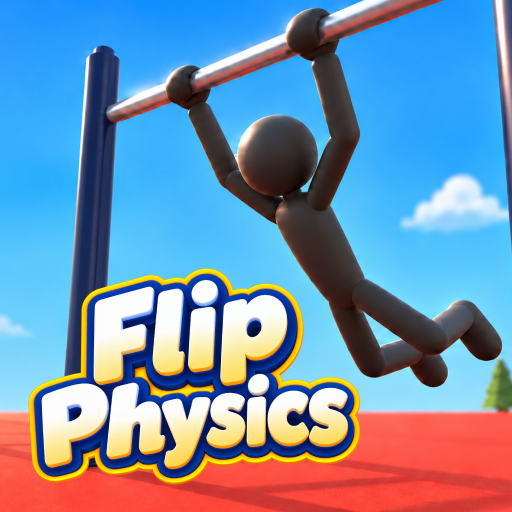
Flip Physics
New Recommended Games

























Flip Physics is a physics-driven acrobatics and gymnastics simulation that gives players command over a ragdoll-like performer moving between horizontal bars. At its core, the experience revolves around an apparently straightforward cycle: swing, let go, rotate, and catch the bar again. Yet truly mastering this sequence demands a solid grasp of momentum, body alignment, timing, and awareness of one’s position in space. In contrast to conventional sports titles that rely on pre-scripted animations, Flip Physics relies on a dynamic physics engine, ensuring that each movement feels organic and inherently unpredictable. Players are constantly required to adapt their strategy based on how the character’s body responds to every swing and midair motion. The outcome is a demanding yet deeply gratifying experience that appeals equally to fans of skill-focused arcade games and those who enjoy physics sandboxes.
The title includes a wide selection of maps and modes, offering players diverse environments and goals to investigate. Whether your aim is to refine a single trick or to string together complex sequences across multiple bars, Flip Physics serves as an ideal playground for experimentation. It rewards persistence, precision, and inventiveness, making it a perfect fit for gamers who take pleasure in mastering mechanics through repeated trial and error. With its ragdoll visual style and controls that are easy to grasp but difficult to fully conquer, Flip Physics distinguishes itself as a unique entry within the casual sports genre.
Flip Physics provides a broad array of features that keep both casual players and committed enthusiasts thoroughly engaged.
The standout element is its physics-based ragdoll movement. Every input causes the character’s body to respond dynamically, producing a convincing sense of weight and inertia that is both demanding and thoroughly enjoyable. No two attempts ever feel identical, which preserves the game’s freshness and pushes players to continually adjust their approach.
The game places strong emphasis on timing and bodily control. Success does not come from pressing buttons randomly or memorizing fixed animation sequences. Instead, players must cultivate a genuine intuition for momentum, rotation, and spatial orientation. This mechanical complexity creates a satisfying learning curve that rewards focused, deliberate practice.
Another important feature is the diversity of maps and modes. Each environment introduces new layouts, bar configurations, and visual motifs, ensuring that the fundamental mechanics stay engaging over the long term. Exploring these locations adds an element of discovery, since players must tailor their tactics to fit the particular characteristics of every setting.
The combo system also deserves special mention. Flip Physics motivates players to link multiple actions together, from swinging and releasing to flipping, twisting, and grabbing the bar once more. Constructing lengthy combo chains is not only technically impressive but also immensely satisfying. The game grants you the liberty to express your own approach, whether you favor neat, disciplined routines or daring, high-risk aerial maneuvers.
Furthermore, the game’s presentation perfectly matches its playful physics concept. The ragdoll character animations are amusing and unpredictable, injecting a sense of lighthearted fun into the otherwise technical gameplay. This visual approach broadens the game’s appeal while still offering enough depth to satisfy even the most dedicated players.
Although Flip Physics is easy to understand in theory, becoming proficient requires patience and a readiness to learn from mistakes. Below are several important precautions and tips to help you progress.
First, avoid attempting complex tricks before you have fully mastered the basic swing. The swing serves as the foundation for everything else. Devote time to simply moving back and forth, observing how momentum builds and how the character reacts to different timings. A strong command of the swing will make every subsequent skill much easier to acquire.
Second, make deliberate use of arch and tuck. These controls are powerful means of adjusting your rotation, but they must be applied with clear intent. Pressing buttons without thought often leads to chaotic flips and missed bars. Treat your body position as a steering mechanism. Tuck to accelerate rotation, arch to decelerate it, and study how each movement influences your path through the air.
Third, pay close attention to release timing. The instant you let go of the bar is absolutely crucial. A frequent error is releasing based on how high you are visually rather than on the character’s actual momentum and direction. Aim to release when your swing naturally carries you toward the next bar in a smooth arc. With enough practice, your sense of timing will sharpen considerably.
Fourth, always have a plan for the regrab. Before leaving the bar, you should already have a rough idea of where you intend to land. Keep your gaze fixed on the next bar and modify your aerial motions to bring your body into proper alignment. A stable, controlled catch is far more valuable than a spectacular midair trick. Prioritize positioning over flashiness until you feel fully confident.
Fifth, practice in small, manageable steps. Rather than trying to execute long combo chains immediately, concentrate on perfecting one move at a time. Once you can reliably perform a single flip and regrab, gradually add an extra swing or twist to your routine. Building muscle memory incrementally will lead to far more consistent performance.
Sixth, anticipate unpredictability. Because the game relies on physics-based ragdoll movement, your character may occasionally behave in surprising ways. This unpredictability is an inherent part of the challenge. Do not become discouraged when a carefully planned trick fails because of a minor misalignment. Instead, view every failure as a chance to understand how the physics engine reacts under various conditions.
Seventh, manage your momentum with care. Excessive speed can make your flips difficult to control, while insufficient speed will leave you short of the next bar. Learn to regulate the intensity of your swing and understand how different levels of momentum affect your rotation in the air.
Finally, take the time to explore every available map and mode. Each environment presents its own rhythm and distinct challenges. Playing across multiple maps will enhance your adaptability and deepen your comprehension of the game’s central mechanics. It also keeps the experience fresh and prevents the gameplay from growing monotonous.
Flip Physics is a game that truly rewards commitment and imagination. By respecting its physics, refining your timing, and approaching every attempt with a clear plan, you can turn chaotic ragdoll flips into graceful, controlled routines. Whether you are a casual player seeking an enjoyable challenge or a dedicated enthusiast looking for mechanical depth, Flip Physics delivers an experience that is both entertaining and surprisingly complex.
A: Flip Physics is a ragdoll-style gymnastics and flipping simulator grounded in physics, in which players take command of a character to swing, launch into the air, rotate, release, and reattach to bars.
A: The central goal is to execute gymnastics-inspired bar maneuvers and backward somersaults by generating a fluid swing, letting go at the precise instant, carrying out flips while suspended in midair, then reattaching to the following bar and completing the trick successfully.
A: Achieving success hinges on momentum, the positioning of your body, the precision of your timing, and the ability to correctly re-secure your grip on the bars.
A: Momentum is generated by rhythmically swinging from the bar prior to attempting any maneuver, with a strong emphasis on precise timing and proper bodily alignment.
A: Arch and tuck positions are employed to influence your rotational speed and gain finer command over the flip while you are in the air.
A: You release your grip on the bar at the opportune moment to propel the gymnast skyward, and then modify your body posture during flight to manage rotation, seamlessly blending flips with twists.
A: Following your flips, you get ready to reattach by orienting yourself toward the upcoming bar in a steady posture and reaching it at the ideal moment so that the motion can continue without interruption.
A: Absolutely. You have the freedom to craft combos by linking extended sequences of actions, including swinging, letting go, flipping, twisting, and grabbing the bar again.
A: Start by mastering each individual move on its own, and then merge several re-grabs together to construct impressive, extended combo chains.
A: Indeed, the game features multiple distinct maps spread across different modes, giving you a range of environments to discover and take pleasure in.
A: Flip Physics falls under the category of Sports Games.
At its heart, Flip Physics centers on guiding a ragdoll gymnast who is suspended from a horizontal bar. Your main goal is to execute gymnastic bar stunts and backflips while progressing from one bar to the next. This entire sequence can be separated into a number of distinct stages.
The first step is generating momentum. Swinging on the bar is far more than a cosmetic animation; it forms the basis for every successful maneuver. If you time your swings properly, you can accumulate sufficient velocity to propel yourself upward. The cadence of your swinging dictates both the height you reach and the amount of angular momentum you bring into the subsequent stage. Watch the gymnast’s movements closely and try to internalize the natural rhythm of that pendulum-style oscillation.
Next, you must regulate your body posture through the arch and tuck controls. Arching straightens the body and tends to decelerate rotation, whereas tucking pulls the limbs inward and enables quicker flips. Mastering these commands is crucial for managing your in-air spin and making sure you neither overshoot nor fall short of your intended bar. Much of the game’s complexity emerges from the interaction between momentum and body shape. A precisely timed tuck can be the deciding factor between a smooth regrab and an uncontrolled crash.
Third, releasing the bar at the correct instant is essential. If you let go prematurely or delay your release, your character will travel in an unwanted direction. The optimal moment to let go is determined by your present swing velocity, how far away the next bar is, and the specific trick you plan to attempt. Once you grow accustomed to the game’s physics engine, you will acquire a natural instinct for the proper release timing.
Fourth, once you are in the air, you have the opportunity to execute flips and twists. The game grants you a certain amount of authority over your rotation, enabling you to blend somersaults and spins into a variety of airborne maneuvers. This is the point where creative expression becomes important. You may try straightforward backflips or challenge yourself with more intricate sequences, yet you should never lose sight of the upcoming bar. The objective is not merely to perform spectacular flips, but to orient yourself correctly for a clean catch on the next bar.
Finally, you have to catch hold of the next bar. This is the most challenging element of the entire cycle. Your gymnast must reach the bar in a controlled posture, oriented in the proper direction, and at the appropriate altitude. A successful catch lets you keep your run going and extend your combo. Failing to grab the bar terminates your sequence, making accuracy absolutely critical.
As you advance, you can begin chaining together multiple swings, releases, flips, and regrabs into lengthy combo strings. In effect, Flip Physics transforms into a physics sandbox where you are free to test out extended action sequences. Start by practicing each individual move in isolation, then progressively merge them to craft more and more spectacular routines.