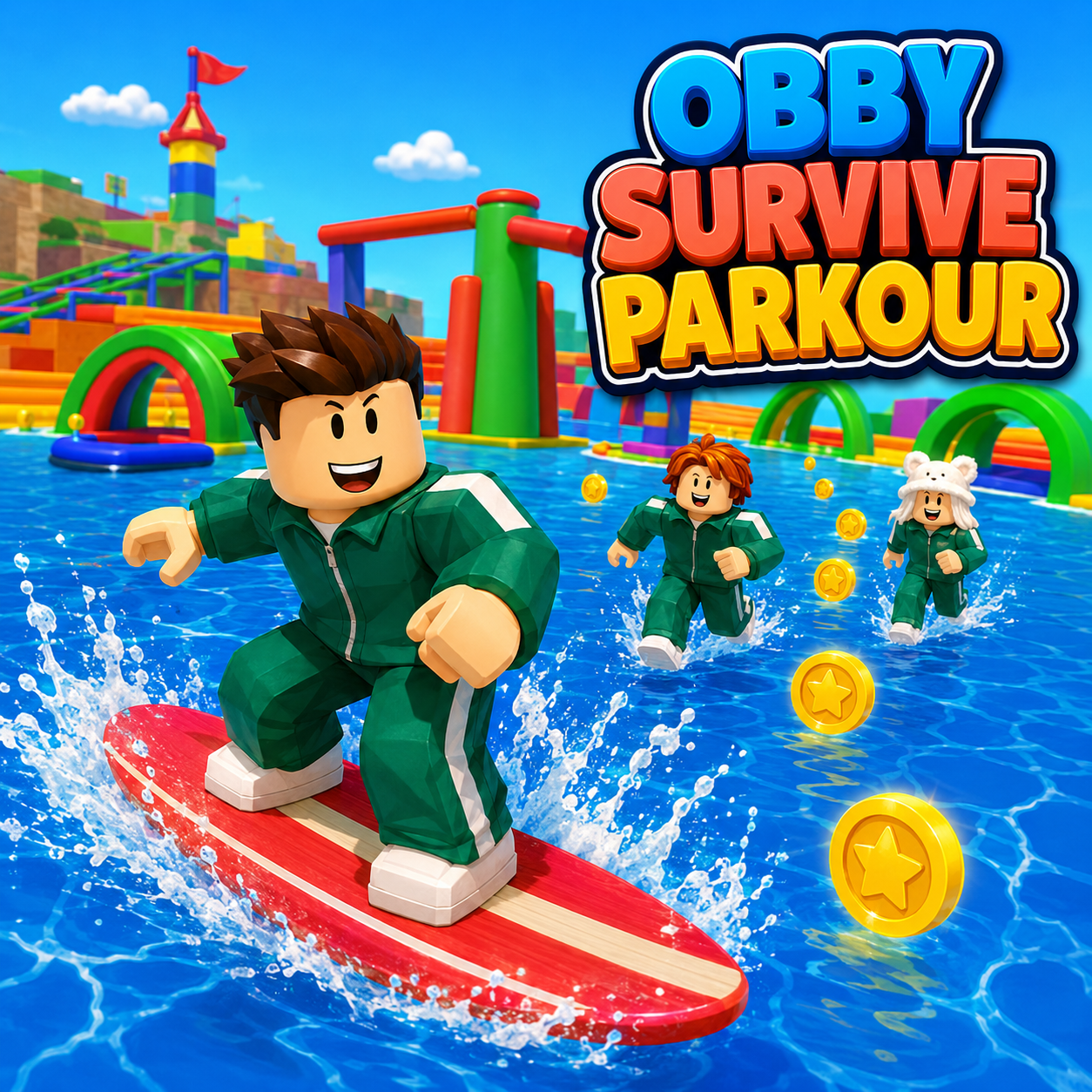
Obby Survive Parkour
New Recommended Games





Obby Survive Parkour, created by gameVgames, is a 3D platforming and survival experience that drops players into obstacle courses shaped by catastrophic events. It supports solo progression and same-screen two-player competition, with the same fundamental goal in both modes: outlast the current stage and cross the finish line. The tracks are composed of tight walkways, raised platforms, environmental snares, and sweeping hazards that can remove anyone standing in an unfortunate spot. What sets Obby Survive Parkour apart from many standard parkour titles is that each disaster fundamentally changes how a player should approach movement. A lava-themed level forces players to climb as molten rock consumes the lower terrain; a tsunami stage requires locating elevated refuge or commandeering a vehicle before the wave arrives; an avalanche storm scenario demands studying the paths of rolling snowballs before crossing open ground; sky parkour segments test pure platforming precision; and red light, green light rounds enforce strict start-stop discipline. Some stages favor quick reflexes, while others call for patience, observation, and deliberate positioning. As a result, mastering one course does not guarantee success on the next. Players must learn not only basic jumping, but also how to identify the safest route within a moving disaster. This combination of 3D platforming, survival instincts, obstacle navigation, two-player racing, and parkour movement gives the game a distinct place among lightweight competitive platformers. Those looking for short, intense sessions will find its accessible controls and varied stage logic immediately appealing.
A: Obby Survive Parkour is a title from gameVgames that blends 3D platforming mechanics with survival-based trials. Its stages are built around slender routes, raised structures, environmental hazards, and sweeping dangers.
A: The game supports both single-player and local two-player experiences.
A: Your aim is to make it through the current stage and arrive at the finish line while avoiding elimination.
A: The level lineup includes Lava, Tsunami, Avalanche Storm, Sky Parkour, and Red Light, Green Light.
A: In the Lava stage, rising molten rock pushes you toward higher platforms. Progressing toward the finish line matters, but every step forward should keep you near another secure spot.
A: A massive wave sweeps through the map. Before it arrives, you must get to elevated terrain or board an available vehicle to stay safe.
A: Huge snowballs roll across the stage and block direct paths. You should track their movement before venturing into open zones.
A: Sky Parkour consists of narrow ledges and floating obstacles, putting extra importance on precise jumps and steady landings.
A: You advance while the signal is green and halt immediately when it turns red. Delaying your start costs time, and braking too late can knock you out of the run.
A: Your character is able to jump twice before touching the ground. A carefully timed second jump increases your distance and can compensate for a poor initial jump. Holding the extra jump until it is truly needed gives you more flexibility than firing both jumps right away.
A: In two-player mode, both competitors are given freeze, bomb, and acceleration powers. Freeze and bomb can disrupt the opponent's progress, while acceleration lets you move across the course faster.
A: Player 1 uses WASD for movement, Space for jumping, Space twice for a double jump, Q for freezing, E for dropping a bomb, and F for acceleration.
A: Player 2 uses the Arrow keys for movement, J for jumping, J twice for a double jump, H for freezing, K for dropping a bomb, and L for acceleration.
A: Approach each level as a constantly shifting challenge. During wave-based stages, locate high ground early; before crossing open sections, study the movement patterns of hazards; and keep your double jump in reserve for tricky landings. In competitive matches, deploy abilities where they can change the outcome without pulling your focus away from the stage's primary threat.
A: The controls stay the same, but the environment around you changes frequently. Each level enforces its own survival rule, and the shifting hazards make path selection, timing, and situational awareness all crucial.
In Obby Survive Parkour, the basic movement mechanics remain uniform across every stage. The first player navigates using WASD, jumps with Space, and performs a double jump by tapping Space twice. The second player controls movement with arrow keys and uses J to jump or double jump. During two-player races, both competitors are granted three special skills: freeze, bomb, and acceleration. The first player triggers freeze with Q, bomb with E, and boost with F, while the second player maps these actions to H, K, and L respectively. These tools can disrupt the rival's rhythm or help you close the gap. The freeze orb and bomb are most effective near a tricky obstacle, since they force the opponent to recover while you continue advancing. The speed boost should be reserved for open sections where maintaining velocity won't cause you to overcorrect into a hazard. Solo play, on the other hand, strips away all special powers, leaving the player to depend entirely on movement skill and the ability to read hazards.
The ever-changing stage conditions demand distinct tactics:
Lava: A climbing lava level compels you to leave lower ground and head for elevated platforms. Progress toward the finish is still essential, but every move should put you within reach of another safe spot. Being caught with no landing zone is not an option.
Tsunami: A massive wave surges through the map. Before it hits, get to higher terrain or take advantage of any nearby vehicle. This level penalizes indecision and favors those who plan ahead.
Avalanche Storm: Huge snowballs barrel across the track, blocking the most direct lines. Study their movement before venturing into open areas. Charging down a route simply because it appears short can be deadly; occasionally, pausing for a few moments is the wiser choice.
Sky Parkour: Thin platforms and floating barriers demand precise launches and careful landings. The double jump becomes essential in this section; a properly timed second press can add extra distance and compensate for a poor initial leap. Hold onto that second jump until it is truly required rather than using both right away.
Red Light, Green Light: Advance only while the signal allows, and halt the instant it switches. Delaying your start costs precious time, but braking too late can eliminate you from the contest. The real test is not simply how fast you react; it is staying composed under pressure.
These scenarios illustrate that victory hinges on identifying the active danger, choosing an appropriate path, and judging the right moment to accelerate. In two-player races, you also have to account for the rival's special powers. Keeping an eye on the other competitor is important, yet losing sight of an approaching wave or the edge of a platform can end your run before anyone else's. The result is a delicate balance between speed and survival: you are never merely attempting to be the quickest; you are also striving to be the most strategic.