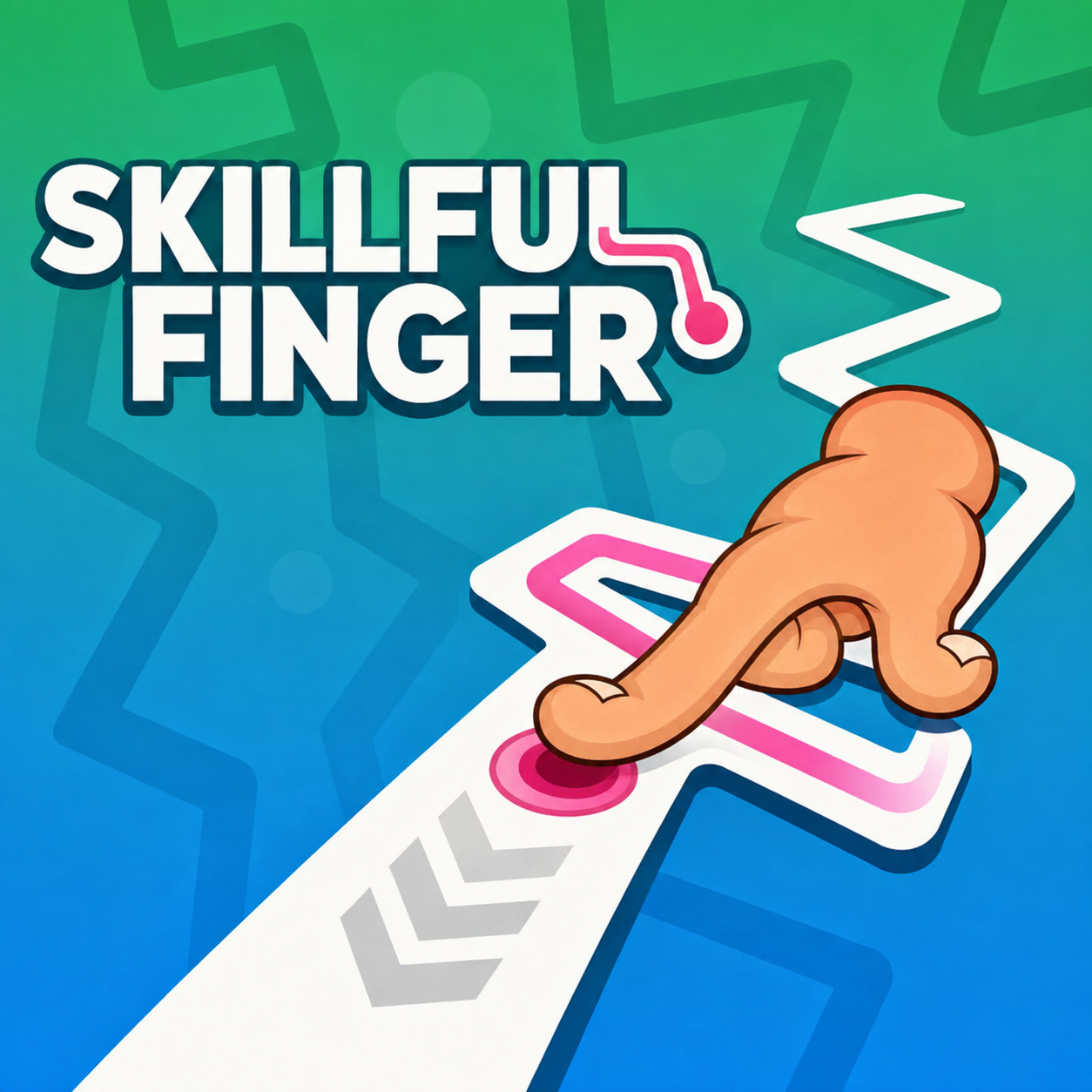
Skillful Finger
New Recommended Games











Skillful Finger is a precision-focused arcade title that condenses its entire challenge into one uninterrupted action: steering a ball along a constantly shifting route while avoiding edge contacts and barrier collisions. At first glance, the mechanics seem almost misleadingly straightforward. You tap a button, guide the ball, and steer clear of threats. In reality, Skillful Finger soon demonstrates that its primary thrill lies in maintaining command while under pressure. Since every attempt terminates the instant the ball makes contact with an obstacle, failure arrives immediately—but so does the opportunity to restart. This concise cycle of brief attempts, rapid feedback, and gradual refinement makes the game especially attractive to fans of pure skill-based challenges.
The experience does not depend on elaborate narratives, character advancement, or inventory systems. Instead, tension is generated through motion and responsiveness. The active pathway rarely remains straight for long; it repeatedly twists, contracts, and alters direction. As a run continues, several additional factors steadily raise the overall difficulty. The game takes the standard precision-runner formula and introduces a more deliberate, controlled tempo, making timing every bit as crucial as reflexes. The resulting test demands steady hands, sharp vision, and the discipline to select the safest moment to advance.
Thus, Skillful Finger is best described as an exercise in consistent reaction. A player who maintains composure, anticipates the upcoming track segment, and employs the pause function wisely is far more likely to achieve a long run than one who merely rushes forward. Button inputs are not solely about speed; they involve positioning, commitment, and fine correction.
Skillful Finger offers a distinct set of features that reinforce its arcade-oriented design:
These elements keep attention fixed on moment-by-moment decision-making rather than on dense manuals or weapon-and-armor menus. The game honors the principle that a demanding runner built on movement and sequencing can be understood through direct control. Newcomers can jump in without a tutorial, while experienced score chasers can focus on perfecting movement routes and optimizing boost patterns.
The golden rule for a successful run is to remain in control. Quick, erratic movements tend to cause more collisions than a slightly slower, more patient approach. Moving at high speed may feel natural, but the risk usually outweighs the benefit.
Always anticipate the next portion of the path, especially when you reach a safe zone. It is better to approach a curve correctly than to attempt a hasty adjustment once the curve is already visible. When a wide section is available, use that extra space to recenter the ball. This reduces the likelihood of an edge collision when a difficult obstacle appears.
Do not overlook the stop mechanic. There will be moments when a moving barrier crosses the path and no gap seems safe. It is perfectly acceptable to halt and wait. Over time, you will recognize which obstacles require immediate crossing and which are better handled with a brief pause. In many cases, a patient player will see the exact moment when an opening becomes safe.
Avoid chasing coins unnecessarily, especially when the path is narrow. Some coins are placed in positions that seem to invite risk for the reward. Before pursuing currency, inspect the upcoming obstacles. If a coin sits too close to a barrier or the obstacle is moving, it may be wiser to skip it. Run length is generally more valuable than a single coin, and it yields more coins later in the run.
On touchscreen devices, remember the importance of a stable finger. Hold the screen firmly and avoid sudden positional changes. Releasing your finger to activate the stop can be risky because it briefly removes you from control. During a maneuver, do not release unless you intend to stop.
Finally, if your goal is to beat a personal best score, keep risk minimal until the game makes a higher score impossible. The best runs come from refusing to touch edges, not from being overly aggressive at every turn. With consistent practice and careful observation, the game's most difficult patterns become manageable. You no longer have to rely solely on extreme reflexes; you can read the path, decide when to wait, and finish with a much more confident run.
A: Skillful Finger is an arcade game built around precise control. In it, you steer a continuously moving ball through tight passages, making sure it never touches the walls or any objects in the way.
A: Your main goal is to remain within the designated safe route, dodge all hazards, and steadily raise your score while the game's difficulty ramps up over time.
A: On a desktop setup, press and hold the left mouse button to take command of the ball. Slide the mouse to move it left or right, and let go of the button to bring it to a halt.
A: For touchscreen devices that are supported, simply touch and hold to control the ball, drag your finger to change direction, and lift your finger to stop.
A: If the ball makes contact with the boundary or any obstacle, the current run ends instantly.
A: In Skillful Finger, gentle and gradual movements tend to be far safer than sudden corrections, since even a slight brush against the border or a hazard will terminate your run.
A: The path frequently curves, constricts, and slides laterally. Because the camera keeps advancing, you must place the ball in the right spot ahead of time, before the more confined segments arrive.
A: In broader sections, staying near the middle leaves you with extra room to maneuver once the next bend or hazard appears on screen.
A: Certain portions of the track feature barriers that travel across the open space. To pass through safely, you need to determine when a gap is clear and pay close attention to the obstacle's movement direction before making your move.
A: Absolutely. By releasing the mouse button or taking your finger off the screen, the ball stops advancing, which lets you pause and wait for moving hazards to reposition themselves more favorably. To resume, simply press and hold again.
A: The coins you gather while playing can be spent on cosmetic unlocks, including alternative ball designs and decorative trail effects.
A: Yes, there is some risk. Certain coins are placed off the most secure path, so going after them demands extra maneuvering and raises the chances of colliding with a hazard.
A: The challenge escalates as the game speeds up and obstacle patterns become more complex. With less time to analyze what lies ahead and fix any bad positioning, you'll find that moving barriers are especially tricky to predict when they appear alongside tight corridors and shifting route directions.
A: Advancing in Skillful Finger relies on three key abilities: precision, timing, and anticipation. You must move with control, wait patiently for secure gaps, and constantly scan ahead so you can position the ball well before the situation demands it.
A: No, there aren't any. Skillful Finger doesn't include intricate upgrade trees or combat mechanics to worry about. Instead, your progress comes primarily from mastering the fundamental gameplay and becoming more consistent with each run.
At the core of Skillful Finger is a remarkably straightforward control scheme that can be grasped within seconds. On a desktop setup, the player holds down the left mouse button and moves the mouse to guide the ball along the track. The ball must stay within the designated safe path at all times, and any contact with the boundary instantly ends the run. On a compatible touchscreen, the interaction is just as simple: the player keeps a finger pressed on the display and drags it to move the ball in the desired direction. Releasing the mouse button or lifting the finger stops forward movement, allowing the player to pause and evaluate the situation before resuming. This stopping mechanic is by no means a hindrance; rather, it is one of the most valuable tools in the entire game.
The course is never static or predictable. The route continually bends, narrows, and shifts from side to side, compelling the player to think ahead and prepare for upcoming challenges. Because the screen advances automatically, waiting until an obstacle is directly in front before reacting is often too late. A far more reliable approach is to position the ball correctly before entering a difficult stretch. In wider sections, maintaining a position near the center of the path leaves more room for the next correction. This small habit can be the deciding factor between a smooth run and an abrupt, unfortunate collision.
Later segments introduce moving barriers that sweep across the safe path. These obstacles demand careful timing rather than mere steering. A gap may appear open at first glance, but by the time the ball arrives, the barrier may have shifted and closed that opening. The best strategy is to observe the movement of the barrier before committing to a change in direction. If the way does not seem clear, the player should hold back and wait rather than risk a dangerous dash through a narrow gap at high speed.
The player is never obliged to keep moving at all times. Releasing the mouse button or lifting a finger from the screen brings the ball to a complete halt. To continue, the player simply presses and holds the left button once more. This capability becomes especially important in dense obstacle patterns, as it enables the player to bide time until a safe opening appears. There is no visible countdown timer, and the track imposes no penalty for pausing; the player is free to decide that stopping is the appropriate course of action. In many cases, precise timing proves far more effective than sheer speed.
Coins are scattered along the route, and collecting them remains entirely optional. Some coins are placed in safer lanes, while others sit just far enough from the most secure path to create a genuine risk-and-reward decision. The player can choose to ignore them for a cautious, uninterrupted run, or take a more adventurous route in order to accumulate extra currency. These collectibles are used to unlock visual customization options, such as different ball appearances and trail effects. This system adds a rewarding sense of purpose to the game without forcing the player to engage with a complicated upgrade structure.
Progress continues as the player completes more runs, but not through unlockable mechanics. Instead, difficulty increases naturally as the game's speed and scoring dynamics evolve. Faster movement leaves less time to read upcoming sections, while more intricate obstacle patterns demand greater positional awareness. Improvement ultimately stems from three core skills: precision, timing, and anticipation. Each successful run is simply a further expression of those fundamental abilities.