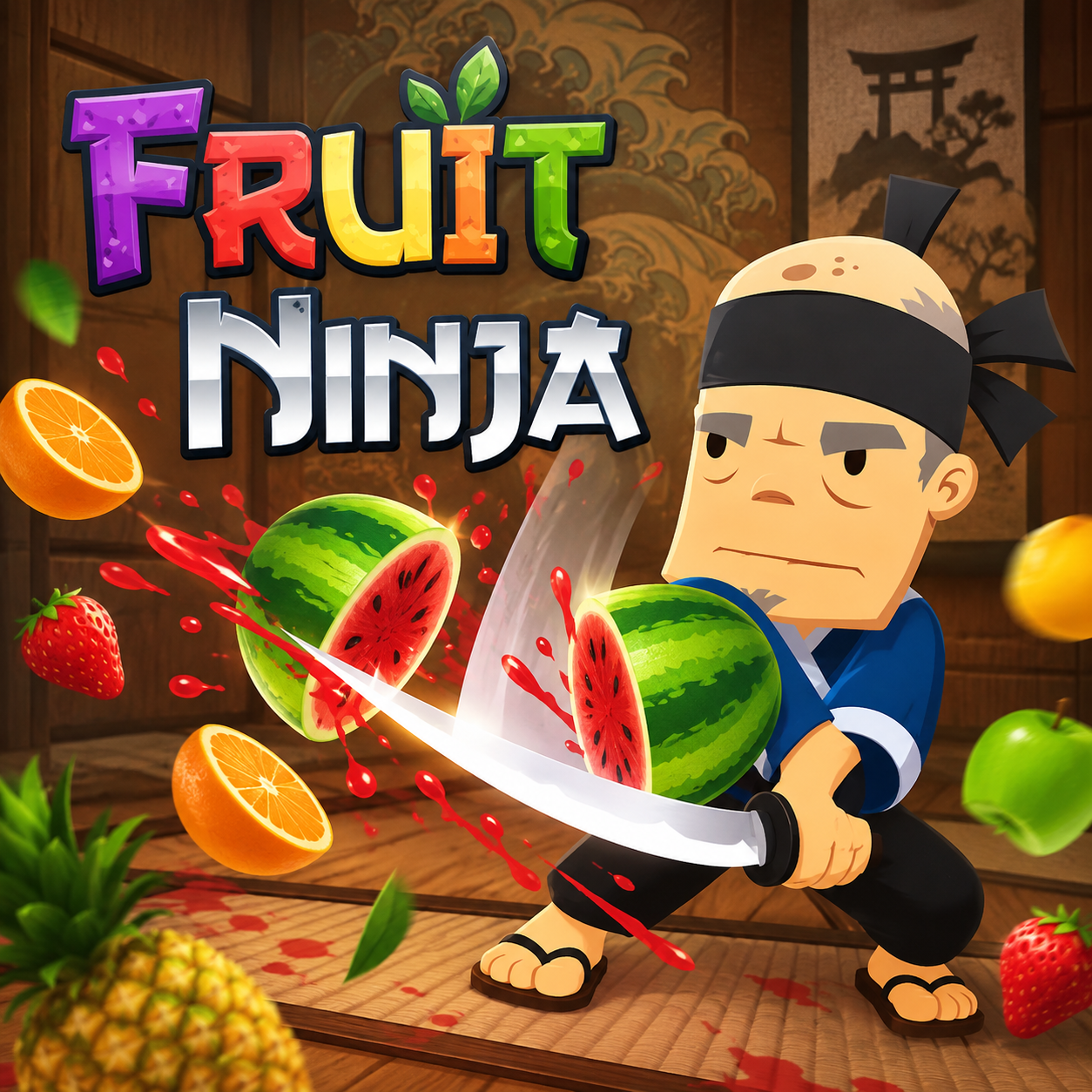
Fruit Ninja
New Recommended Games















Fruit Ninja is a precision action game that distills the arcade-slicing formula into a test of timing, spatial judgment, and controlled aggression. The premise is simple: fruit is launched into the air, and the player must slice as many pieces as possible while avoiding hazards. But the game's true depth lies in reading the trajectory of every object on screen, deciding when to commit to a wide swing, and knowing when a single calculated cut is worth more than a risky multi-fruit sweep.
The player's blade follows the exact path traced by the mouse or fingertip, which means every slice is a direct expression of player intent. Fruit rises from the bottom of the screen, decelerates near the top of its arc, and then falls back out of reach. This creates a natural rhythm: early cuts are safe but limited, while waiting for multiple pieces to group together offers the potential for higher combo scores. Bombs are mixed into the airborne clutter and must never be touched, adding a layer of risk assessment to every decision.
Fruit Ninja offers three distinct modes, each with a different objective and scoring philosophy. Classic mode emphasizes survival with no time limit, ending only after three missed fruits or a single bomb strike. Zen mode provides a 90-second, bomb-free environment for players who want to focus on clean technique and combo-building. Arcade mode is a 60-second sprint where dropped fruit carries no penalty, bombs deduct points instead of ending the run, and bonus bananas can dramatically alter the pacing. Together, these modes transform a straightforward slicing mechanic into a versatile skill game with room for both cautious strategists and aggressive score chasers.
For game enthusiasts, Fruit Ninja is more than a casual distraction. It rewards pattern recognition, hand-eye coordination, and disciplined decision-making. The controls are immediately accessible, but the scoring systems and hazard layouts ensure that mastery requires constant attention and deliberate practice.
Fruit Ninja's design is built around a small set of core features that create a surprisingly rich gameplay experience. The most obvious feature is the intuitive swipe-based slicing mechanic. Because the blade follows the player's exact input path, there is no character animation or projectile delay between intention and action. This direct control scheme makes the game easy to approach while still providing a meaningful skill ceiling.
The three game modes are a central part of the game's appeal. Classic mode offers a survive-as-long-as-possible challenge. There is no clock, so every decision carries weight: one wrong move can end the run, but a patient, careful approach can extend it indefinitely. Zen mode provides a 90-second relaxed session with no bombs and no miss penalties. It is the ideal training ground for learning fruit trajectories and perfecting combo timing. Arcade mode, meanwhile, is a 60-second scoring frenzy. Its lack of miss penalties encourages bold play, while the bomb penalty system prevents total recklessness.
Combo scoring is another defining feature. By slicing multiple fruits in a single continuous stroke, players earn significantly higher point totals than they would from separate cuts. This encourages the player to think in terms of patterns rather than individual slices. Successful runs are built around long, deliberate diagonal movements that sweep across the upper portion of the screen, where fruit tends to cluster. The need to maintain accuracy while moving quickly creates a constant mental challenge.
The presence of bombs adds a risk-reward dimension to every swipe. Bombs are deliberately placed among the fruit, forcing the player to remain aware of the entire screen at all times. In Classic mode, a single bomb is fatal. In Arcade mode, bombs reduce the score but allow the run to continue. This difference influences how the player approaches each mode: caution dominates Classic, while calculated risk-taking defines Arcade.
Finally, the cross-platform controls make Fruit Ninja a flexible experience. The game runs equally well on desktop with a mouse and on touch devices with a fingertip. The core mechanics remain consistent, meaning that skills developed on one platform carry over to the other. This accessibility, combined with the depth of the scoring systems, makes Fruit Ninja a satisfying title for players who enjoy games that are easy to learn but hard to fully master.
The most important precaution in Fruit Ninja is to scan the full path before committing to a slice. Since the blade cuts through everything along its route, a wide and careless swipe can easily cross a bomb. Players should trace an imaginary line from the starting point of the intended swipe to the ending point and verify that every object in that path is safe to cut. If a bomb is close to the fruit cluster, shorten the stroke and accept a smaller combo. A reduced score is always preferable to losing the run entirely.
In Classic mode, survival should be the primary focus. The round does not end when the player misses a single fruit; it ends after three misses or one bomb. This means that a calculated miss is sometimes the correct decision. If a fruit is positioned directly beside a bomb, or if the only way to reach it requires crossing an explosive, it is better to let that fruit fall. Taking one miss is far less damaging than ending the entire run on a bomb. New players often make the mistake of trying to slice every fruit on screen, but experienced players understand that some fruit is intentionally placed as a trap.
Zen mode is the safest place to practice and refine technique. Because it removes bombs and eliminates penalties for missed fruit, it isolates the core mechanics of timing and combo-building. Players who struggle with hitting multiple targets should use Zen mode to experiment with different swipe angles and lengths. Pay attention to where fruit reaches its slowest point, as that is the easiest moment to intercept it. Practicing diagonal strokes from the lower corners toward the upper center can help build the muscle memory needed for high-scoring runs.
In Arcade mode, the priority is scoring speed, but players should not ignore bombs entirely. A bomb costs only 10 points, while a successful combo can earn much more. This means that it is sometimes worthwhile to take a risky swipe if the reward is a large multi-fruit combo. However, players should still avoid unnecessary bomb hits, especially when the Freeze or Double Points banana is active. During a Double Points bonus, every fruit is worth double, so avoiding bombs becomes even more important. Save aggressive risk-taking for moments when the potential gain clearly outweighs the penalty.
Finally, remember that the blade can be as precise or as broad as the player chooses. Short, rapid strokes are useful in crowded areas where bombs are likely to be hidden. Longer strokes generate more combo momentum but cover more ground and therefore carry more risk. Vary the length and direction of swipes according to the current layout. By staying adaptable and always reading the screen before cutting, players can turn a simple swipe into a high-scoring, bomb-free performance.
A: Fruit Ninja is a skill-based game where you slice fruit as it flies across the screen, line up combos, and avoid bombs mixed into each batch. It offers three modes with different rules for varied challenges.
A: The three modes are Classic, Zen, and Arcade. Classic has no time limit and ends when you miss three fruits or hit a bomb. Zen gives you 90 seconds with no bombs and no penalties for missed fruit. Arcade is a 60-second scoring challenge with no penalty for dropped fruit, but bombs deduct 10 points.
A: Classic has no fixed time limit. The round ends when you miss three fruits or hit a bomb, unless a protective item saves you. Accuracy keeps the run alive, so letting one awkward fruit fall can be better than slicing through an explosive.
A: Zen gives you 90 seconds with no bombs and no penalties for missed fruit. It is designed for practising smooth cuts and grouping targets into combos without worrying about survival.
A: Arcade is a 60-second scoring challenge with bonus action and no penalty for dropped fruit. Bombs deduct 10 points rather than ending the round, so the priority is collecting points quickly while keeping costly mistakes under control.
A: On desktop, hold the left mouse button and drag through fruit to slice.
A: On mobile or tablet, swipe your finger across the screen to slice fruit.
A: Your blade follows the path you draw, allowing one continuous stroke to slice several pieces of fruit and earn combo points. Using long, diagonal swipes can help slice several fruits together when the path is clear.
A: Bombs complicate timing. A wide sweep may catch an entire group of fruit but also cross an explosive beside it. In Classic mode, hitting a bomb ends the round. In Arcade mode, bombs deduct 10 points instead of ending the round. Zen mode has no bombs.
A: Arcade mode includes Freeze and Double Points bananas. Slicing Freeze slows the action, while Double Points increases your scoring potential.
A: Fruit rises from the bottom of the screen, slows near the top of its arc, and falls out of reach. Near the top of their arcs, fruit is easier to track, making this a useful moment to judge your angle.
A: Tips include lining up combos with long, diagonal swipes; checking for bombs along your intended swipe before cutting; prioritizing Arcade bonuses like Freeze and Double Points bananas; and practising in Zen mode to learn fruit trajectories and improve timing before tackling Classic or Arcade.
A: Cutting immediately helps you catch individual fruit, while waiting briefly can bring several targets into a single swipe. Near the top of their arcs, fruit is easier to track, making this a useful moment to judge your angle.
A: No. Check the full path before cutting, and use shorter strokes when hazards crowd the fruit. Good runs depend on knowing when a large combo is worth the risk, especially when bombs are nearby.
The basic action of Fruit Ninja is easy to understand but difficult to perfect. The player must slice fruit that is launched into the air from the bottom of the screen. Each piece follows a parabolic trajectory: it rises, slows near the peak of its arc, and then accelerates downward. To slice fruit, the player must drag the blade through the fruit's visual body. On desktop, this is done by holding the left mouse button and moving the cursor. On mobile or tablet, the player simply swipes a finger across the screen.
The blade path matters as much as the timing. Because the cut is continuous, a single unbroken swipe can pass through several pieces of fruit in one motion. This is the foundation of the combo system. Slicing multiple targets with one stroke generates more points than slicing them individually, and skilled players actively position their cuts to intersect several pieces at once. However, the player must also account for bombs. Bombs are visually distinct hazardous objects that end the round in Classic mode or subtract points in Arcade mode. A careless wide swipe can catch a bomb that was hidden just outside the intended target path.
Effective play begins with observation. Since fruit slows down near the top of its arc, that is often the best moment to judge its exact position and choose a safe angle. Waiting a split second longer can allow multiple pieces to cluster, making a diagonal stroke especially effective. But waiting also risks missing a piece if it falls out of reach. The player must balance speed and precision with every movement.
In Classic mode, the absence of a timer creates a more patient game. The objective is to keep the round alive by avoiding mistakes. Missing three fruits ends the run, and touching a bomb ends it immediately. Therefore, players should sometimes deliberately allow a difficult fruit to fall if slicing it would mean cutting through a nearby explosive. In Zen mode, bombs are removed completely, and missed fruit carries no consequence. This creates a low-pressure environment where the player can focus on smooth, well-timed strokes and practice grouping multiple targets into a single combo.
Arcade mode changes the equation by introducing a countdown and a points penalty for bombs. Dropped fruit is ignored, which frees the player to concentrate on scoring as fast as possible. The presence of bonus bananas, such as Freeze and Double Points, adds another layer of strategy. Freeze slows the action briefly, while Double Points multiplies the value of fruit sliced during the effect. Knowing when to chase these bonuses and when to simply keep the combo train moving is a key part of Arcade mastery.