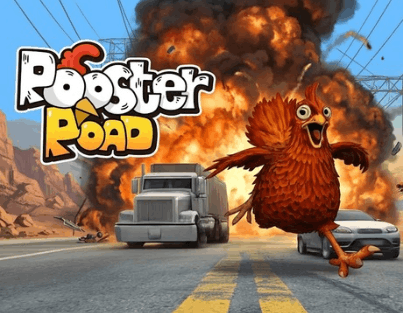
Rooster Road
New Recommended Games


















At first glance, Rooster Road appears to be a straightforward arcade title built around the classic premise of getting a chicken across a busy thoroughfare. However, beneath that simple façade lies an intense reflex-based challenge where every decision can mean the difference between survival and disaster. In this game, players guide a rooster through multiple lanes of traffic, with vehicles moving at different speeds and coming from various directions. Unlike conventional endless runners that keep the character moving forward automatically, Rooster Road requires a more deliberate and calculated approach. Each step must be perfectly timed, every gap in traffic must be carefully assessed, and every choice carries its own set of risks. The game’s charm comes from its clean, uncluttered design—there are no convoluted mechanics to learn, no extensive instructions to read, and no distractions beyond the rooster, the asphalt, and a seemingly infinite stream of cars, trucks, and other obstacles. Yet underneath this simplicity, there is a remarkably deep strategic layer waiting to be explored. Players are constantly forced to weigh boldness against caution, the temptation of extra points against the necessity of staying alive, and the urge to move quickly against the value of waiting for the right moment. The end result is a game that welcomes newcomers within seconds but continues to provide a rewarding level of difficulty for experienced gamers. Its quick run-based format, combined with steadily increasing challenges, creates a powerful “just one more attempt” cycle that draws players back to the roadside again and again.
Rooster Road stands out from other games in its genre through a number of thoughtful design decisions that appeal strongly to fans of arcade action and reflex-driven gameplay:
Rooster Road is simple to learn, but those who hope to rack up impressive distances should approach it with a sense of patience and discipline. The following recommendations and cautionary notes will help you increase your chances of survival and steer clear of frequent errors.
In the end, Rooster Road is a game that rewards patience, careful observation, and a healthy respect for the dangers of the road. Players who can resist the temptation to take reckless chances and who learn to work with the traffic rather than against it will find the experience both genuinely challenging and immensely satisfying.
A: Rooster Road is an entertaining arcade game in which you take command of a tiny hen navigating highways filled with cars, trucks, and various other vehicles that speed past without pause.
A: Your primary mission is to guide the chicken safely across the roadway to reach the opposite side.
A: The road surface is in constant motion, with automobiles approaching from multiple angles. Areas that are momentarily safe tend to vanish very quickly.
A: Rather than dashing ahead nonstop, it is wiser to scan the surroundings and pick the optimal opportunity to advance. At times, moving backward is the smarter option to steer clear of peril.
A: With further progress, evading obstacles becomes considerably harder, and ongoing traffic keeps producing unpredictable circumstances.
A: Power-ups (bonuses) grant useful benefits and add extra fun to the experience, yet attempting to collect them can put you in jeopardy if a heavy stream of vehicles lies ahead.
A: Patience is essential. Rather than charging forward impulsively, pay attention to the movement patterns of nearby traffic, slip through safe openings, and be willing to turn back when needed.
A: The attraction comes from the urge to try just once more. A single round can end abruptly, pushing the player to give it another attempt and beat their previous best score.
A: After each loss, take note of the exact move that led to the mistake, so the next run can be handled more effectively.
A: Definitely. As your reaction time becomes sharper, even routes that once appeared totally chaotic start to feel much more manageable.
A: Cuby Road is cited as a game with strong similarities.
A: Cuby Road delivers straightforward yet demanding arcade action that emphasizes fine control, deft obstacle avoidance, and rapid reflexes. Anyone can pick it up easily, yet achieving high scores remains a real challenge.
Rooster Road employs a deceptively simple control scheme that is intuitive to pick up yet challenging to fully command. The player guides the rooster along the roadway, moving it either forward or backward as needed. This two-way locomotion forms the heart of the experience. The road itself is never fixed; traffic may stream in from the left, right, or other angles, and the intervals of safety between vehicles are perpetually in flux. As a result, the player must carefully read the ongoing traffic, pinpoint a viable opening, and make a move precisely when the time is right. Knowing when to retreat is just as critical. Should a car close in more rapidly than anticipated, stepping back to a prior spot can prevent a crash.
The initial stretches of the road are quite lenient, affording players the opportunity to absorb the game's tempo. Once the rooster moves further, vehicle congestion grows heavier and movement patterns become increasingly unpredictable. In addition, power-ups appear, granting short-lived benefits. Yet these bonuses tend to be situated in hazardous zones. The player must weigh the possible gain against the inherent risk. The final goal remains pushing the rooster to the greatest distance achievable. Each attempt concludes swiftly, but the knowledge gained from every failure lays the groundwork for a more successful run.