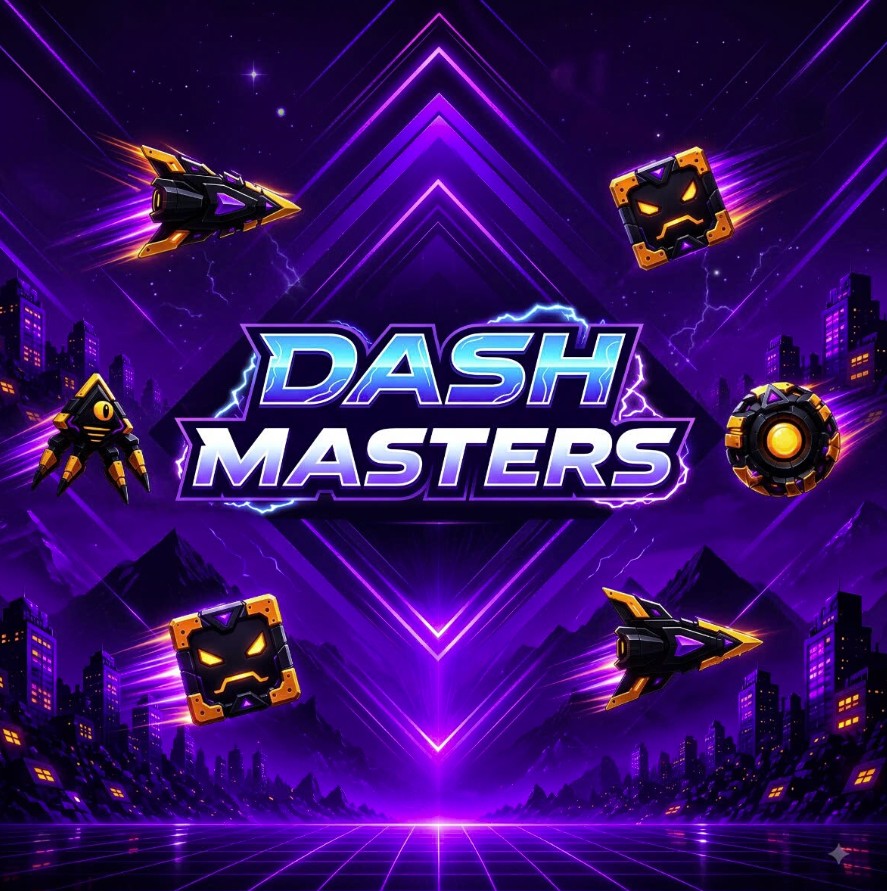
Dash Masters
New Recommended Games





Dash Masters is a high-tempo rhythm platformer that has captured the attention of players who enjoy demanding, precision-based gameplay. Drawing clear inspiration from the Geometry Dash school of design, the game strips away extraneous mechanics and focuses on one of the purest challenges in gaming: moving forward relentlessly while mastering every obstacle in your path. The result is an experience that balances simplicity with depth, requiring not only fast fingers but also careful timing and pattern recognition. Whether you are a veteran of rhythm games or a newcomer looking for an intense arcade challenge, Dash Masters offers a polished and rewarding environment. The following sections examine the game’s core premise, playstyle, standout attributes, and essential guidance for improving performance.
Dash Masters is a fast-paced rhythm platformer centered around a constantly moving icon that must traverse obstacle-dense levels. Combining the precision of geometric platforming with the auditory feedback of a musical score, the game demands timing, memory, and near-immediate reactions. Players face a gauntlet of spikes, saws, moving hazards, and gravity-defying portals, all while the soundtrack drives the pace. The primary objective is straightforward: guide the icon from the start of each level to the finish without crashing. Each attempt ends in quick restart, encouraging players to learn from mistakes and slowly map out the correct path. Inspired by the core mechanics of Geometry Dash, Dash Masters distills the rhythm-platformer formula into a polished and accessible package. It rewards consistent rhythm and careful observation rather than random button mashingverbally? Need "rather than random input spamming". The game's design ensures that every death offers a lesson, and every victory comes from mastery.
Getting into Dash Masters is easy; mastering it is another story. The controls are minimal. On PC, you can use the mouse, the Spacebar, or the Up Arrow key to make your icon jump. On mobile devices, a tap on the screen performs the same action. Since your character automatically moves forward, you never have to worry about acceleration or braking. Instead, the entire gameplay loop is reduced to a single choice: when to jump.
That simplicity is deceptive. Every spike, saw, and platform must be timed with precision. A jump executed one frame too early or too late usually ends the run. The game steadily introduces new mechanics to keep you alert. Portals are the most significant of these. Some portals reverse gravity, forcing you to rethink your orientation instantly. Others alter the speed of your icon, meaning the distance covered by a jump changes mid-run. Some portals shift your icon into a different form, such as a cube or a ship-like state, each with unique physics. These transformations demand rapid adaptation and a deep understanding of the game's core movement.
One of the most valuable tools for learning is Practice Mode. In this mode, you can place checkpoints at any point in the level. This allows you to tackle a single difficult segment without having to replay the entire stage from the beginning. Practice Mode is not a crutch, but a strategic necessity. The game's levels are long and precise, and trying to learn a late-game section through repeated full runs is inefficient. By isolating the troublesome portions, you can dedicate focused attention to the exact jump timings and portal transitions. Once those moments become second nature, you can stitch everything together in a full run.
The most important skill to develop is rhythm. Because Dash Masters synchronizes obstacles and musical beats, players who rely solely on visual reaction will often find themselves overwhelmed. Instead, subconsciously counting through the music allows you to commit jump timings to memory. The early levels ease you into this mindset with broader gaps and slower tempos. Later stages demand faster, more precise responses, and the music becomes an essential guide rather than merely background flavor enemy? Need "rather than just background audio."
Dash Masters may look minimal, but its feature set is carefully designed to create depth and variety within an apparently simple framework. Below are the defining aspects of the experience.
Simple yet responsive controls: The control scheme is intentionally barebones. With just a single jump input on PC or mobile, the game eliminates mechanical complexity and focuses difficulty on timing. The resulting precision is satisfying for players who appreciate skill-based arcade styling.
Continuous forward motion: The icon never stops moving, and you cannot alter its speed or direction. Instead, you must coordinate your jumps based on what appears ahead. This limitation is the heart of the challenge easiness? Actually "core" not "limitation". It forces players to think in advance, watching the path ahead and preparing mentally for the next obstacle.
Portals and transformation mechanics: Some sections contain portals that completely change how the icon behaves. A gravity reversal portal flips the world upside down, requiring you to land on ceilings. Speed portals accelerate or slow down the action, altering the timing of every subsequent jump. These features prevent the game from feeling monotonous and add an extra layer of strategic consideration, especially when multiple portals appear in quick succession.
Rhythm-based level design: The game's obstacles are not randomly placed. The stage layouts are synchronized with the music, so many jumps feel like notes in a composition. This synchronization is more than an aesthetic choice—it provides a reliable timing reference. Players who can feel the beat will find the game more intuitive and less chaotic.
Practice Mode: This mode is invaluable for players serious about clearing difficult levels. It allows you to place checkpoints and repeatedly attempt a short section without starting over from the beginning. Instead of being an optional extra, it is effectively a training tool for pattern recognition and muscle memory development.
Scalable difficulty curve: Dash Masters begins forgiving enough to teach you the basics, then gradually introduces faster tempos, denser hazards, and more complex portal combinations. The curve is designed to make you feel genuine improvement as you progress, while still offering a stiff challenge for veteran players.
Success in Dash Masters comes down to mental preparation, familiarity, and controlled reflexes. The first and most important piece of advice is to treat failure as a learning mechanism, not as a setback. Every crash is a data point: it tells you that a jump was too early, too late, or mistimed relative to the music. The sooner you accept death as a natural part of the learning process, the quicker you will progress.
One of the most effective strategies is to listen to the music actively. Rather than focusing solely on the visual hazards, try to recognize the underlying beat structure. Many obstacles will align with downbeats and rhythmic accents. If you find yourself missing the same jump repeatedly, try closing your eyes for a moment and feeling the pulse of the track. You may find that your body instinctively knows when to jump, even before your conscious brain processes the obstacle. This kind of audio-motor coordination is a core part of the Dash Masters experience.
For sections involving portals, it is wise to break them down mentally. When you enter a gravity reversal or a speed shift, the geometry of the course remains the same but your relationship to it changes dramatically. Practice these transitions in Practice Mode until your hands naturally adjust. It also helps to keep a peripheral awareness of what comes immediately after a portal, because your first jump after a mechanic change is often the most dangerous.
Dash Masters can be a mentally demanding game. Because of the tiny margin for error and the requirement for precise timing, frustration can quickly set in. The most important tip is to remain calm and treat each attempt as an experiment. Instead of expecting immediate completion, focus on progressing one obstacle at a time. Memorizing the pattern of a level is not a shortcut but an essential part of the intended experience.
When approaching a new section, try to identify a reference point—a specific musical beat, a visual cue on the ground, or a platform edge—that triggers your jump. Anchoring your timing to consistent signals reduces the chance of jumping too early or too late under pressure. The same applies when a speed portal changes the pace; the visual cue and the rhythm both shift, so do not simply rely on what worked in the previous sectioncars? Wait, need word? We'll do: "...so do not rely purely on what worked in the previous segment."
For players who feel stuck, the best move is to step away for a short break. Fatigue degrades reflexes and attention, and continuing to play while frustrated often leads to sloppy inputs. Returning with a fresh mind can make a difficult section feel significantly more manageable. Also, be mindful of the screen and input device. A clean, responsive mouse or a stable touch screen makes a noticeable difference in a game that measures timing in fractions of a second.
Finally, do not ignore the audio. Playing with the sound off removes one of the most important feedback systems the game provides. The music is not decorative; it is a map to the level's layout. For maximum control, keep the volume at a comfortable level and let the beat enter your muscle memory. Over time, your jumps will feel less like calculations and more like natural responses, which is exactly the state of mind that Dash Masters is designed to cultivate. With persistence, discipline, and a good ear, even the most treacherous courses can be conquered.
A: Dash Masters is a fast-paced rhythm platformer inspired by Geometry Dash's core gameplay. You control a constantly moving icon and must react quickly to obstacles.
A: The goal is to survive from the beginning of a level to the end without crashing.
A: On PC, you can use the mouse, Spacebar, or Up Arrow to jump.
A: On mobile, you tap the screen to jump or interact.
A: Yes, your icon continuously moves forward on its own.
A: Obstacles include spikes, saws, platforms, portals, and other hazards.
A: Portals can change gravity, speed, or your current movement form.
A: Music provides an important rhythm cue that helps you anticipate many obstacles.
A: Practice Mode lets you slow down and learn difficult patterns one obstacle at a time, which is helpful when a section feels impossible.
A: Yes, levels introduce faster movement and trickier layouts, making each attempt harder.
A: The action is tied to music, and using rhythm cues helps you time jumps and anticipate obstacles.
A: Repeating attempts helps you memorize patterns, and Practice Mode allows you to learn sections one obstacle at a time.
At its heart, Dash Masters is a one-button game. On PC, players can use the mouse, Spacebar, or Up Arrow key to make the icon jump. On mobile, a simple tap on the screen does the same. The icon moves forward automatically, so the only responsibility is to execute clean jumps at the correct moments. Levels are filled with hazards such as spikes, saws, and moving platforms. Touching any of these immediately ends the runduct? Yes, "ends the run" and sends you back to the start. Timing is therefore everythingaren't have "therefore" maybe.
Obstacles are arranged in rhythmic patterns, and often the music will give you hints. Pay attention to the beat: many jumps are intentionally placed on strong musical accents. You can also use Practice Mode to drop checkpoints near tough sectionsad? Need "near tough sections" but in Geometry Dash practice mode allows checkpoints? Actually yes. Use it.
Need mention "some sections introduce portals that..." etc.
Need ensure no "metadata" like reviews, votes. Okay.
Need maybe "Dash Masters" from game name. Good.
Need maybe include "Precautions/Tips" with headings? Done.
Let's final with polished text.
Need maybe "article must include sections" so use headings exactly. We can have intro paragraph under title, then ### Summary. That's okay. But maybe "Return the article directly" no preamble. So final starts with title and content. Need no extra.
Let's count. Let's maybe use an intro paragraph then sections.
Need ensure "Key Features" bullet list. "Precautions/Tips" paragraph list. "How to Play" explanatory. "Summary" overview. Good.
Let's produce final.### Summary
Dash Masters is a rhythm-based platformer that distills the high-risk, high-reward gameplay of the genre into a clean and demanding arcade experience. Inspired directly by the core mechanics of Geometry Dash, the game places you in control of an icon that moves forward automatically, forcing you to focus entirely on timing rather than movement direction. Each level is a gauntlet of spikes, saws, moving platforms, and portals that can alter gravity, speed, and movement behavior.
The objective is simple: survive from the beginning to the end of each course without crashing. What makes Dash Masters compelling, however, is its intricate marriage of audio and visual design. The obstacles are often arranged in time with the music, meaning a player who listens carefully can anticipate jumps almost instinctively. This creates a flow state that is both tense and exhilarating. The game is built around repetition and mastery—early attempts may end in failure, but each death teaches something new about the layout, the timing windows, and the rhythm of the stage. For game enthusiasts, especially those who enjoy precision platformers and rhythm titles, Dash Masters provides a polished and addictive challenge that values skill, patience, and focus above all else.