Pikwip
New Recommended Games








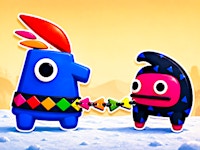
Pikwip is an appealing yet subtly demanding two-player platformer that emphasizes collaborative teamwork. Conceived by Cookiecrayon over a span of 72 hours for the Mini Jam: Summit competition, the game requires players to steer two small adventurers, Pik and Wip, toward the peak of a frost-covered mountain. The central gameplay mechanism involves controlling both characters simultaneously: one player takes charge of a single character using distinct keyboard keys, or a lone player can undertake the arduous challenge of handling both characters alone. The level design features slippery ice platforms, tricky leaps, and physics-oriented obstacles that demand exact timing and mutual assistance. Although the visuals are charming and calm, the actual gameplay is far from easy, offering a genuine trial of coordination, perseverance, and tactical planning. The current demo concludes after a segment with falling rocks, and the developer has stated that no significant content exists beyond this point. There is no time cap, so players can methodically address each obstacle. Pikwip distinguishes itself as a clever, stripped-down cooperative experience that prioritizes collaboration above everything else.
zard.
The game does not provide a tutorial. Players learn through repeated attempts and trial and error. Jumps require careful timing, and because the characters are tiny and the platforms are slick, accuracy is essential. No timer imposes pressure, so participants can spend as much time as necessary to strategize each movement. The primary loop involves ascending, crossing gaps, dodging falling boulders, and resolving basic physics-based puzzles that require both characters to occupy specific positions simultaneously. Working together—whether between two human participants or between the two hands of a single player—is the sole path forward.
Q: What is Pikwip? A: Pikwip is an endearing yet surprisingly difficult 2-player platform game in which teamwork serves as your most valuable asset for ascending a snow-covered mountain peak. You take charge of two diminutive explorers called Pik and Wip, scrambling across frozen platforms, surviving awkward leaps, and ensuring both characters progress together toward the summit.
Q: Who are the two characters in Pikwip? A: The two small beings are named Pik and Wip. Your aim is to assist both characters in reaching the mountain's highest point.
Q: Can I play Pikwip alone? A: Absolutely! You can manage both Pik and Wip by yourself. However, be ready for an additional level of difficulty. Numerous players remark that managing both characters at once is considerably harder than playing alongside a companion.
Q: What are the controls for Pikwip? A: The first player uses WASD to guide Pik, while the second player employs the Arrow Keys to control Wip.
Q: Is Pikwip similar to Chained Together? A: Certain parallels exist. Both titles transform climbing and platforming into a cooperative endeavor where synchronizing with another character becomes essential. However, Pikwip provides a far more adorable and laid-back wintry setting, featuring straightforward keyboard commands and local co-op gameplay.
Q: Who developed Pikwip? A: Pikwip was crafted by Cookiecrayon. The original prototype was built within just 72 hours for Mini Jam: Summit, adhering to the competition's Summit theme and its restriction that games could only utilize WASD and the Arrow Keys.
Q: Is there more content after the falling rocks? A: The falling-rock segment signifies the conclusion of the initial demo. Based on the developer's replies to users, it might technically be feasible to advance further, but no significant demo content exists beyond that point.
Q: Is there a time limit to finish the level? A: No countdown timer is present! You are free to take your time planning your jumps, solving the physics-based puzzles, and flawlessly aligning your actions without feeling rushed.
Q: What is the main challenge of playing Pikwip solo? A: Community members often mention that solo play transforms a comfortable platformer into a demanding test of coordination. Some have humorously labeled it an exercise in ambidexterity.
Q: What is the setting of Pikwip? A: The game takes place on a snowy mountain, where you traverse slippery platforms and overcome challenging jumps.
Q: What genre does Pikwip belong to? A: Pikwip is a 2-player platform game classified under genres such as Adventure, Balance, Escape, Fun, Jumping, Kids, and Platform.
Q: What is the objective in Pikwip? A: Your goal is to guide both characters, Pik and Wip, to the mountain's summit.
Q: What happens if you don't have a second player? A: You can still engage with the game by controlling both characters on your own, which transforms it into a substantially more demanding coordination challenge.
Q: Is Pikwip a timed game? A: No, there is no time constraint. You may take as much time as necessary to finish the level.
Q: What other games are recommended for fans of Pikwip? A: Suggested titles include Pico Park Scratch, where cooperation is vital, and G-Switch 3, a fast-paced gravity-defying runner featuring intense local multiplayer.
The goal of Pikwip is simple: lead both Pik and Wip to the summit of the mountain. The entire game is operated solely through keyboard input, with no need for a mouse or gamepad. The first player manages Pik using the WASD keys, whereas the second player handles Wip via the arrow keys. Each character moves independently, and both must survive the entire journey. The game is structured as a local cooperative experience, meaning that both participants share a single display and keyboard.
When playing solo, the identical control scheme remains in effect, but a single individual must operate both key sets simultaneously. This shifts the gameplay from a collaborative journey to a challenging test of multitasking. The player needs to switch between or merge inputs to navigate both characters over platforms, synchronize their leaps, and guarantee that neither character drops off the screen or into a hazard.