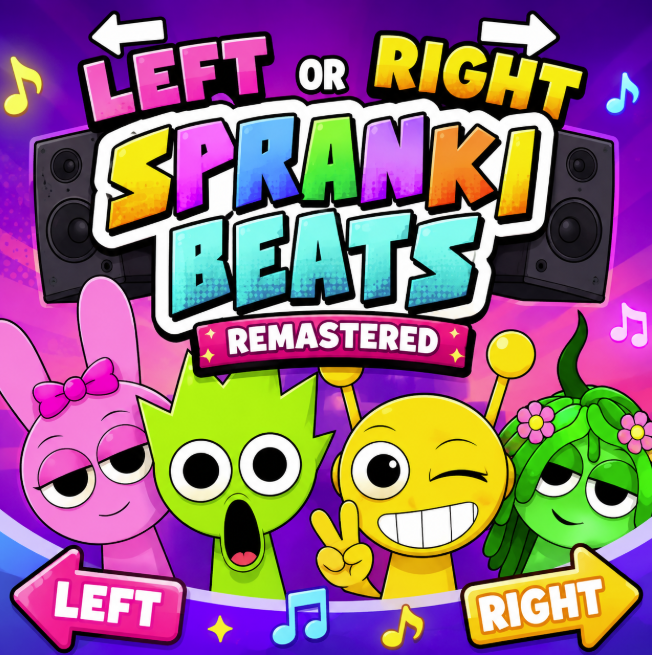
Left Or Right Spranki Beats
Nieuwe aanbevolen spellen


















Left or Right: Spranki Beats is an inventive rhythm game that distills the genre to its purest essence: a binary choice between two directions, synchronized with a musical pulse. Unlike conventional titles that demand complex button combinations, scrolling note highways, or dense visual feedback, this game strips the experience down to a single, elegant question—will your next move be left or right? The result is an engaging hybrid of reflex testing, pattern recognition, and auditory perception, delivering the thrill of a rhythm action game without entangled controls or overloaded interfaces.
The premise is simple: as music plays, the game issues prompts indicating which side of the screen to select. In its most basic form, the player must choose the correct side to match the cue. Timed with the accompanying track, each attempt maintains rhythmic consistency and builds a sensorial link between what you hear and what you do. The design ethos is accessibility—anyone can pick it up and understand the core loop within seconds—but the escalating speed and dynamic patterns ensure that seasoned players are not left with a shallow experience. Each track contains its own embedded rhythm signature, requiring the player to internalize the beat and predict the next prompt. The later tracks and advanced modes demand superior reactions, rhythmic intuition, and the ability to remain composed under tempo pressure. With a clear, intuitive user interface, visually unambiguous signals, and a compulsion loop that roars within minutes, Left or Right: Spranki Beats is a title that respects both newcomers and hardcore leaners within the niche, becoming an instant recommendation to rhythm game enthusiasts looking for a fresh twist on reflex-based gaming.
To get the most out of Left or Right: Spranki Beats, implement the following pratiche suggestions handed down from rhythm veterans:
Left or Right: Spranki Beats is an engaging meta-rhythm game that combines stark minimalism with robust depth. It honors the core principles of rhythm gameplay—practicing timing, memorization, and anticipation, and it wraps them in a simple two-digit access. For pros, more advanced modes provide a true benchmark of their reflexes, and for new players the onset and tutorials are a welcoming introduction. The real joyhere is in that small moment when the beat and your choice align flawlessly. So pick a side, focus, and let the music guide you.
Now check if we include all sections. "Précautions/Tips" spelling? We must use exactly "Precautions/Tips". In the summary, "How to Play" etc. We'll adjust if header case.
Also, the content mentions "rythm" but we should use correct "rhythm". Our article is in English.
We need about 1000 words. Let's count our draft. It's quite long; I'm not sure exact. I'll write more concise summary perhaps to balance. Let's estimate: Summary around 250 words, How to Play ~200, Key Features ~150, Tips ~300, closing ~100? Total ~1000. Good.
Now produce Markdown with headers as required. Ensure no extra preambles.
Let's final### Summary
Left or Right: Spranki Beats is an inventive rhythm game that distills the genre to its purest essence: a binary choice between two sides, synchronized with a musical pulse. Unlike conventional rhythm titles that rely on dense note highways, complex button combinations, or scrolling sliders, this game strips away all extraneous systems and leaves only the fundamental challenge—do you choose left or right, and can you do it exactly on the beat? The result is a seamless hybrid of timing, pattern recognition, and auditory intuition that offers a refreshingly accessible entry point for newcomers while still providing a substantial test for seasoned players.
The core premise is elegantly simple: prompts appear on screen indicating a left or right position, and the player must select the corresponding side in tune with the rhythm of a given track. Each track is built around its own rhythmic structure, requiring the player to internalize temporal spacing and anticipate when the next cue will arrive. The early tracks act as a gentle tutorial, encouraging players to grasp the basic flow. As the player advances, the speed increases, the patterns become more irregular, and the greater accuracy becomes mandatory. What sets this title apart, aside from its purity, is the speed at which it escalates—within the first hour, the game transitions from a casual listen-and-tap pastime to a high-stakes test of auditory processing and micro-decision accuracy. The vibe is intuitive for novices but deeply rewarding for those wanting to measure rhythm. Ultimately, Left or Right: Spranki Beats strips away all noise and entrusts you with a core primal wonder: can you be on the beat?
When you step into the game, you are greeted by a clean interface with a minimal selection of songs. Begin with an easier track to become comfortable with the rhythm and control. The playable is incredibly straightforward: during the song, you will see cues appear that guide you to choose the left or right side. Your task is to press the corresponding button or touch the appropriate area just as the beat hits. The crucial element is not how quickly you react, but how accurately you land each selection in tempo. Instead of smashing the input as fast as possible, you must listen to the beat and "slot" your move inside the groove.
Each song uses directional sounds, visual flashes, or pan effects to inform which side to pick. The base mode combines visual arrows and musical accents. A slow, steady tempo helps teach the fundaments; later songs feature more complex offbeat patterns that will break your anticipation. To play well, you need to develop both your peripheral vision and your sense of pulse. One useful method is to mentally "silence" the visual cue and rely on the rhythmic grooves for your hints. This is especially important because the game features four distinct modes, each with a unique rule on the classic left/right selection:
Each mode has its own skill curve, and players can switch between them to train different aspects of perception. Use the early tracks as pure training; do not rush to hardest difficulty, as you need to build your internal beatmap.
Successful play is not just about how quick you click—others have to be careful about the whole rhythm experience. Here are several tips to improve performance and avoid common pitfalls:
To sum up, remember: precision over raw speed, solid hearing, spatial awareness, and clear mental maps. Left or Right : Spranki Beats is a celebration of minimal groove. The player is invited to enter a musical loop where their input becomes the beat. It's the whole what – feel of sensorial gratification and sound added. That's the summit to master: not just be able to choose, but to choose in complete humanity to tune.
A: Left Or Right Spranki Beats is een op ritme gebaseerd spel dat boeiende melodieën, snelle reflexen en eenvoudige richtingsbeslissingen combineert. Terwijl de muziek speelt, observeer je aanwijzingen op het scherm en kies je op het juiste moment de juiste kant.
A: Het centrale doel is om links of rechts te kiezen op basis van de getoonde aanwijzingen, zodat je keuze synchroon loopt met de muzikale beat.
A: Helemaal niet. Er zijn geen ingewikkelde bedieningsschema's; je enige taken zijn luisteren naar de soundtrack, letten op de aanwijzingen en de juiste richting kiezen.
A: Absoluut. De kernmechanismen zijn eenvoudig genoeg voor nieuwkomers om snel te begrijpen, en de introductietracks zijn speciaal ontworpen om spelers vertrouwd te maken met hoe het spel werkt.
A: Ja, dat doet het. Het tempo van de patronen versnelt geleidelijk, en de latere tracks vereisen snellere reflexen en een verfijnder gevoel voor timing en ritme.
A: Het spel bevat vier verschillende spelmodi. Afhankelijk van welke modus je kiest, moet je mogelijk reageren op muzikale ritmes, reageren op audiocues, visuele indicatoren volgen of je aanpassen aan veranderende patroonstructuren.
A: Elke modus introduceert zijn eigen variatie op de fundamentele links/rechts-keuzemechanica, waardoor de ervaring fris en boeiend blijft. Sommige modi benadrukken muzikale timing, andere richten zich op geluidsgebaseerde reacties, sommige vertrouwen op visuele signalen, en een paar combineren deze elementen met veranderende patronen.
A: Beginners moeten beginnen met een langzamer nummer en zich concentreren op de komende aanwijzingen. Wanneer het spel links aangeeft, beweeg dan naar links; wanneer het rechts aangeeft, beweeg dan naar rechts. Probeer elke beweging precies op tijd met het ritme te maken.
A: Als een reeks overweldigend begint te voelen, neem dan een mentale stap terug en concentreer je op het verwerken van slechts één aanwijzing tegelijk in plaats van te proberen het hele patroon in één keer te verwerken.
A: Precieze timing is veel belangrijker dan pure snelheid. Let goed op de muziek zodat je kunt voorspellen wanneer de volgende richtingskeuze verschijnt en reageer dienovereenkomstig.
A: Houd je blik gericht op het gebied waar de aanwijzingen verschijnen, minimaliseer onnodige hand- of lichaamsbewegingen, en speel nummers regelmatig opnieuw zodat je veelvoorkomende ritmische patronen leert en instinctiever reageert.
A: Zodra je je comfortabel voelt met de fundamentele patronen, daag jezelf dan uit door over te stappen naar snellere nummers en veeleisendere modi die je reactietijd en ritmische nauwkeurigheid op de proef stellen.
A: De leercurve is zowel plezierig als bevredigend, met eenvoudige bediening die gemakkelijk te leren is, een verscheidenheid aan modi om te verkennen, en nummers die steeds moeilijker worden om je uit te blijven dagen.
A: Dit spel is een uitstekende keuze voor ritmeliefhebbers die een creatieve draai aan de traditionele ritmegameformule waarderen en graag hun timing en besluitvormingsvaardigheden testen.
Bij het starten van Left Or Right Spranki Beats krijgen spelers een verscheidenheid aan nummers aangeboden. Voor nieuwkomers wordt aangeraden om met een eenvoudiger nummer te beginnen om de kernritme te begrijpen en te zien hoe aanwijzingen zich ontwikkelen. De mechanica is eenvoudig: er verschijnen aanwijzingen die aangeven of je de linker- of rechterkant moet kiezen. Je reageert dan door te tikken of op de toets te drukken die overeenkomt met die kant. Timing is alles—je invoer moet overeenkomen met het ritme van de beat, in plaats van alleen te vertrouwen op het onthouden van de volgorde.
De eerste fase fungeert als een interactieve tutorial, die geleidelijk meer aanwijzingen introduceert en het tempo bepaalt. Beginners moeten zich concentreren op het weergavegebied en wachten tot het visuele signaal verschijnt. Let tegelijkertijd op de muziek en probeer je reactie te synchroniseren met de beat. Willekeurig zo snel mogelijk klikken zal je score verlagen; het spel bestraft onzorgvuldig knopgestamp. Precisie in timing wordt meer gewaardeerd dan ruwe snelheid. In alle modi blijft het kernprincipe constant—kies links of rechts wanneer er een aanwijzing verschijnt—maar de vorm van die aanwijzing kan aanzienlijk variëren.
De vier modi:
Links of Rechts (Klassiek) – Dit is de basismodus. Aanwijzingen worden getoond als pijlen of tekst met 'LINKS' en 'RECHTS'. De muziek en visuele indicator komen tegelijkertijd aan, waardoor er twee gelijktijdige signalen zijn die je helpen snel een verbinding op te bouwen.
Alleen-geluidmodus – Hier worden alle directe visuele aanwijzingen verwijderd. In plaats daarvan luister je naar een uniek audiosignaal—zoals een geluid dat scherp naar links of rechts is gepanned, of een muzieknoot die uit een specifiek kanaal komt. Jouw taak is om de bronkant te identificeren en zonder vertraging te reageren. Deze modus scherpt je luistervaardigheden aan en daagt je reactiesnelheid uit.
Visuele aanwijzingsmodus – Deze modus verwijdert muzikale begeleiding en vertrouwt uitsluitend op visuele indicatoren, zoals een kleurflits of een object dat aan één kant beweegt. Het vereist bijna onbewuste verwerking, en de moeilijkheid neemt toe naarmate de snelheid toeneemt.
Patroonverschuivingsmodus – Deze modus combineert elementen van de andere. Auditieve en visuele signalen kunnen nog steeds aanwezig zijn, maar de cruciale wending is dat de regels tijdens een nummer kunnen veranderen—bijvoorbeeld dat je plotseling de tegenovergestelde kant moet selecteren, of dat de links/rechts-oriëntatie kan worden omgedraaid. Spelers moeten constant alert blijven op de veranderende omstandigheden.
Elke modus behoudt de schijnbare eenvoud van het kiezen van links of rechts, maar elke modus verandert het niveau van mentale inspanning dat vereist is. Regelmatig wisselen tussen hen traint de hersenen om scherpe onderscheidingen te maken.