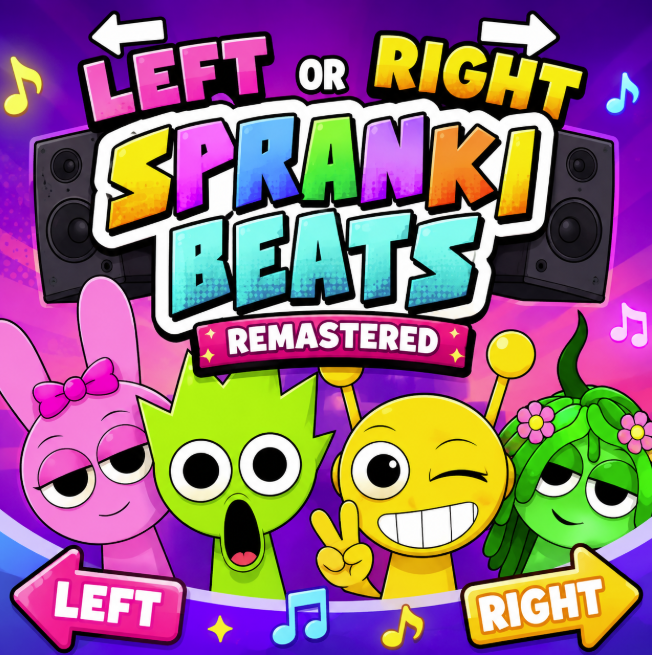
Лево или Право Spranki Beats
Новые рекомендуемые игры




















Left or Right: Spranki Beats is an inventive rhythm game that distills the genre to its purest essence: a binary choice between two directions, synchronized with a musical pulse. Unlike conventional titles that demand complex button combinations, scrolling note highways, or dense visual feedback, this game strips the experience down to a single, elegant question—will your next move be left or right? The result is an engaging hybrid of reflex testing, pattern recognition, and auditory perception, delivering the thrill of a rhythm action game without entangled controls or overloaded interfaces.
The premise is simple: as music plays, the game issues prompts indicating which side of the screen to select. In its most basic form, the player must choose the correct side to match the cue. Timed with the accompanying track, each attempt maintains rhythmic consistency and builds a sensorial link between what you hear and what you do. The design ethos is accessibility—anyone can pick it up and understand the core loop within seconds—but the escalating speed and dynamic patterns ensure that seasoned players are not left with a shallow experience. Each track contains its own embedded rhythm signature, requiring the player to internalize the beat and predict the next prompt. The later tracks and advanced modes demand superior reactions, rhythmic intuition, and the ability to remain composed under tempo pressure. With a clear, intuitive user interface, visually unambiguous signals, and a compulsion loop that roars within minutes, Left or Right: Spranki Beats is a title that respects both newcomers and hardcore leaners within the niche, becoming an instant recommendation to rhythm game enthusiasts looking for a fresh twist on reflex-based gaming.
To get the most out of Left or Right: Spranki Beats, implement the following pratiche suggestions handed down from rhythm veterans:
Left or Right: Spranki Beats is an engaging meta-rhythm game that combines stark minimalism with robust depth. It honors the core principles of rhythm gameplay—practicing timing, memorization, and anticipation, and it wraps them in a simple two-digit access. For pros, more advanced modes provide a true benchmark of their reflexes, and for new players the onset and tutorials are a welcoming introduction. The real joyhere is in that small moment when the beat and your choice align flawlessly. So pick a side, focus, and let the music guide you.
Now check if we include all sections. "Précautions/Tips" spelling? We must use exactly "Precautions/Tips". In the summary, "How to Play" etc. We'll adjust if header case.
Also, the content mentions "rythm" but we should use correct "rhythm". Our article is in English.
We need about 1000 words. Let's count our draft. It's quite long; I'm not sure exact. I'll write more concise summary perhaps to balance. Let's estimate: Summary around 250 words, How to Play ~200, Key Features ~150, Tips ~300, closing ~100? Total ~1000. Good.
Now produce Markdown with headers as required. Ensure no extra preambles.
Let's final### Summary
Left or Right: Spranki Beats is an inventive rhythm game that distills the genre to its purest essence: a binary choice between two sides, synchronized with a musical pulse. Unlike conventional rhythm titles that rely on dense note highways, complex button combinations, or scrolling sliders, this game strips away all extraneous systems and leaves only the fundamental challenge—do you choose left or right, and can you do it exactly on the beat? The result is a seamless hybrid of timing, pattern recognition, and auditory intuition that offers a refreshingly accessible entry point for newcomers while still providing a substantial test for seasoned players.
The core premise is elegantly simple: prompts appear on screen indicating a left or right position, and the player must select the corresponding side in tune with the rhythm of a given track. Each track is built around its own rhythmic structure, requiring the player to internalize temporal spacing and anticipate when the next cue will arrive. The early tracks act as a gentle tutorial, encouraging players to grasp the basic flow. As the player advances, the speed increases, the patterns become more irregular, and the greater accuracy becomes mandatory. What sets this title apart, aside from its purity, is the speed at which it escalates—within the first hour, the game transitions from a casual listen-and-tap pastime to a high-stakes test of auditory processing and micro-decision accuracy. The vibe is intuitive for novices but deeply rewarding for those wanting to measure rhythm. Ultimately, Left or Right: Spranki Beats strips away all noise and entrusts you with a core primal wonder: can you be on the beat?
When you step into the game, you are greeted by a clean interface with a minimal selection of songs. Begin with an easier track to become comfortable with the rhythm and control. The playable is incredibly straightforward: during the song, you will see cues appear that guide you to choose the left or right side. Your task is to press the corresponding button or touch the appropriate area just as the beat hits. The crucial element is not how quickly you react, but how accurately you land each selection in tempo. Instead of smashing the input as fast as possible, you must listen to the beat and "slot" your move inside the groove.
Each song uses directional sounds, visual flashes, or pan effects to inform which side to pick. The base mode combines visual arrows and musical accents. A slow, steady tempo helps teach the fundaments; later songs feature more complex offbeat patterns that will break your anticipation. To play well, you need to develop both your peripheral vision and your sense of pulse. One useful method is to mentally "silence" the visual cue and rely on the rhythmic grooves for your hints. This is especially important because the game features four distinct modes, each with a unique rule on the classic left/right selection:
Each mode has its own skill curve, and players can switch between them to train different aspects of perception. Use the early tracks as pure training; do not rush to hardest difficulty, as you need to build your internal beatmap.
Successful play is not just about how quick you click—others have to be careful about the whole rhythm experience. Here are several tips to improve performance and avoid common pitfalls:
To sum up, remember: precision over raw speed, solid hearing, spatial awareness, and clear mental maps. Left or Right : Spranki Beats is a celebration of minimal groove. The player is invited to enter a musical loop where their input becomes the beat. It's the whole what – feel of sensorial gratification and sound added. That's the summit to master: not just be able to choose, but to choose in complete humanity to tune.
Ответ: Left Or Right Spranki Beats — это ритм-игра, сочетающая захватывающие мелодии, быструю реакцию и простые решения о направлении. Пока играет музыка, вы наблюдаете за подсказками на экране и выбираете нужную сторону в точный момент.
Ответ: Главная цель — выбрать левую или правую сторону в зависимости от отображаемых подсказок, чтобы ваш выбор совпал с музыкальным битом.
Ответ: Совсем нет. Здесь нет сложных схем управления; ваши задачи — слушать саундтрек, следить за подсказками и выбирать правильное направление.
Ответ: Безусловно. Основные механики достаточно просты, чтобы новички быстро освоились, а вступительные треки специально разработаны для ознакомления с игрой.
Ответ: Да. Темп паттернов постепенно ускоряется, и более поздние треки требуют более быстрой реакции и более точного чувства времени и ритма.
Ответ: В игре четыре различных игровых режима. В зависимости от выбранного режима вам может потребоваться реагировать на музыкальные ритмы, отвечать на звуковые сигналы, следовать визуальным индикаторам или адаптироваться к изменяющимся структурам паттернов.
Ответ: Каждый режим вносит свои вариации в основную механику выбора левой/правой стороны, сохраняя свежесть и увлекательность. Некоторые режимы подчеркивают музыкальный тайминг, другие сосредоточены на звуковых реакциях, третьи полагаются на визуальные сигналы, а некоторые сочетают эти элементы с изменяющимися паттернами.
Ответ: Новичкам следует начать с более медленного трека и сосредоточиться на предстоящих подсказках. Когда игра сигнализирует «влево», двигайтесь влево; когда «вправо» — вправо. Старайтесь делать каждое движение точно в такт ритму.
Ответ: Если последовательность начинает казаться сложной, сделайте мысленный шаг назад и сосредоточьтесь на обработке одной подсказки за раз, а не пытайтесь обработать весь паттерн сразу.
Ответ: Точный тайминг гораздо важнее, чем просто скорость. Внимательно слушайте музыку, чтобы предугадывать, когда появится следующий выбор направления, и реагируйте соответствующим образом.
Ответ: Держите взгляд в области появления подсказок, минимизируйте лишние движения рук или тела и регулярно переигрывайте треки, чтобы выучить типичные ритмические паттерны и реагировать более инстинктивно.
Ответ: Когда вы почувствуете себя уверенно с базовыми паттернами, бросьте себе вызов, перейдя к более быстрым песням и более требовательным режимам, которые проверяют ваше время реакции и точность ритма.
Ответ: Кривая обучения приятная и удовлетворяющая: простые в освоении управление, разнообразие режимов для изучения и треки, которые постепенно усложняются, чтобы поддерживать вызов.
Ответ: Эта игра отлично подойдет любителям ритм-игр, которые ценят творческий подход к традиционной формуле ритм-игр и любят проверять свои навыки тайминга и принятия решений.
При запуске Лево или Право Spranki Beats игрокам предлагается множество треков. Новичкам рекомендуется начинать с более простого трека, чтобы понять основной ритм и понять, как развиваются подсказки. Механика проста: появляются сигналы, сообщающие, какую сторону выбрать — левую или правую. Затем вы отвечаете, нажимая на соответствующую сторону или клавишу. Тайминг решает всё — ваш ввод должен совпадать с ритмом бита, а не полагаться только на запоминание порядка.
Начальный этап действует как интерактивный учебник, постепенно вводя больше подсказок и задавая темп. Новичкам следует сосредоточиться на области отображения и ждать появления визуального сигнала. Одновременно обращайте внимание на музыку и старайтесь синхронизировать свой ответ с битом. Случайное нажатие как можно быстрее снизит ваш счет; игра наказывает за небрежное нажатие кнопок. Вместо этого точность тайминга ценится больше, чем скорость. Во всех режимах основной принцип остается постоянным — выбирайте лево или право при появлении подсказки, но форма этой подсказки может значительно различаться.
Четыре режима:
Лево или Право (Классика) – Это базовый режим. Подсказки отображаются в виде стрелок или текста «ЛЕВО» и «ПРАВО». Музыка и визуальный индикатор появляются одновременно, предоставляя два одновременных сигнала, которые помогают быстро установить связь.
Режим только звука – Здесь все прямые визуальные подсказки убраны. Вместо этого вы слушаете уникальный аудиосигнал — например, звук, резко смещенный влево или вправо, или музыкальную ноту, исходящую из определенного канала. Ваша задача — определить сторону источника и ответить без задержки. Этот режим оттачивает навыки слушания и бросает вызов скорости реакции.
Режим визуальных подсказок – Этот режим убирает музыкальное сопровождение и полагается только на визуальные индикаторы, такие как вспышка цвета или движение объекта на одной стороне. Он требует почти подсознательной обработки, и сложность возрастает с увеличением скорости.
Режим смены паттернов – Этот режим сочетает элементы других. Звуковые и визуальные сигналы могут присутствовать, но ключевой поворот в том, что правила могут меняться во время трека — например, внезапно нужно выбрать противоположную сторону, или ориентация лево/право может быть перевернута. Игроки должны постоянно быть внимательными к меняющимся условиям.
Каждый режим сохраняет кажущуюся простоту выбора лево или право, но каждый меняет уровень требуемых умственных усилий. Регулярное переключение между ними тренирует мозг на резкие различия.