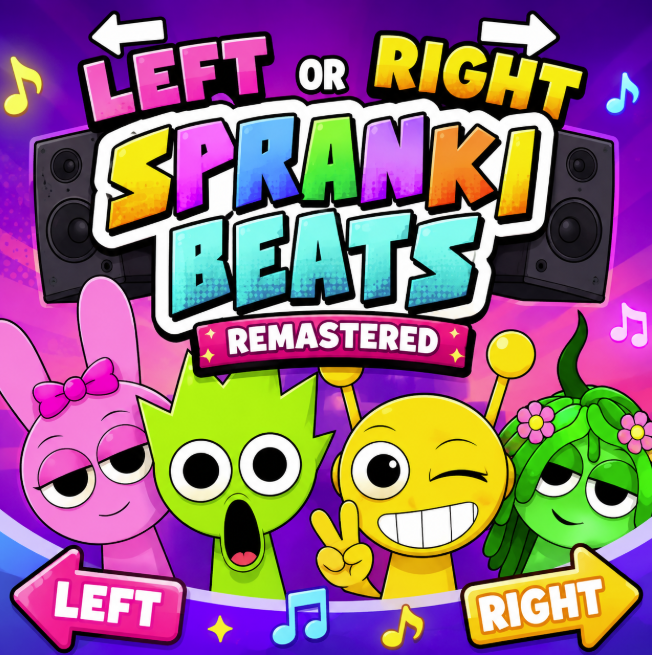
Left Or Right Spranki Beats
เกมแนะนำใหม่















Left or Right: Spranki Beats is an inventive rhythm game that distills the genre to its purest essence: a binary choice between two directions, synchronized with a musical pulse. Unlike conventional titles that demand complex button combinations, scrolling note highways, or dense visual feedback, this game strips the experience down to a single, elegant question—will your next move be left or right? The result is an engaging hybrid of reflex testing, pattern recognition, and auditory perception, delivering the thrill of a rhythm action game without entangled controls or overloaded interfaces.
The premise is simple: as music plays, the game issues prompts indicating which side of the screen to select. In its most basic form, the player must choose the correct side to match the cue. Timed with the accompanying track, each attempt maintains rhythmic consistency and builds a sensorial link between what you hear and what you do. The design ethos is accessibility—anyone can pick it up and understand the core loop within seconds—but the escalating speed and dynamic patterns ensure that seasoned players are not left with a shallow experience. Each track contains its own embedded rhythm signature, requiring the player to internalize the beat and predict the next prompt. The later tracks and advanced modes demand superior reactions, rhythmic intuition, and the ability to remain composed under tempo pressure. With a clear, intuitive user interface, visually unambiguous signals, and a compulsion loop that roars within minutes, Left or Right: Spranki Beats is a title that respects both newcomers and hardcore leaners within the niche, becoming an instant recommendation to rhythm game enthusiasts looking for a fresh twist on reflex-based gaming.
To get the most out of Left or Right: Spranki Beats, implement the following pratiche suggestions handed down from rhythm veterans:
Left or Right: Spranki Beats is an engaging meta-rhythm game that combines stark minimalism with robust depth. It honors the core principles of rhythm gameplay—practicing timing, memorization, and anticipation, and it wraps them in a simple two-digit access. For pros, more advanced modes provide a true benchmark of their reflexes, and for new players the onset and tutorials are a welcoming introduction. The real joyhere is in that small moment when the beat and your choice align flawlessly. So pick a side, focus, and let the music guide you.
Now check if we include all sections. "Précautions/Tips" spelling? We must use exactly "Precautions/Tips". In the summary, "How to Play" etc. We'll adjust if header case.
Also, the content mentions "rythm" but we should use correct "rhythm". Our article is in English.
We need about 1000 words. Let's count our draft. It's quite long; I'm not sure exact. I'll write more concise summary perhaps to balance. Let's estimate: Summary around 250 words, How to Play ~200, Key Features ~150, Tips ~300, closing ~100? Total ~1000. Good.
Now produce Markdown with headers as required. Ensure no extra preambles.
Let's final### Summary
Left or Right: Spranki Beats is an inventive rhythm game that distills the genre to its purest essence: a binary choice between two sides, synchronized with a musical pulse. Unlike conventional rhythm titles that rely on dense note highways, complex button combinations, or scrolling sliders, this game strips away all extraneous systems and leaves only the fundamental challenge—do you choose left or right, and can you do it exactly on the beat? The result is a seamless hybrid of timing, pattern recognition, and auditory intuition that offers a refreshingly accessible entry point for newcomers while still providing a substantial test for seasoned players.
The core premise is elegantly simple: prompts appear on screen indicating a left or right position, and the player must select the corresponding side in tune with the rhythm of a given track. Each track is built around its own rhythmic structure, requiring the player to internalize temporal spacing and anticipate when the next cue will arrive. The early tracks act as a gentle tutorial, encouraging players to grasp the basic flow. As the player advances, the speed increases, the patterns become more irregular, and the greater accuracy becomes mandatory. What sets this title apart, aside from its purity, is the speed at which it escalates—within the first hour, the game transitions from a casual listen-and-tap pastime to a high-stakes test of auditory processing and micro-decision accuracy. The vibe is intuitive for novices but deeply rewarding for those wanting to measure rhythm. Ultimately, Left or Right: Spranki Beats strips away all noise and entrusts you with a core primal wonder: can you be on the beat?
When you step into the game, you are greeted by a clean interface with a minimal selection of songs. Begin with an easier track to become comfortable with the rhythm and control. The playable is incredibly straightforward: during the song, you will see cues appear that guide you to choose the left or right side. Your task is to press the corresponding button or touch the appropriate area just as the beat hits. The crucial element is not how quickly you react, but how accurately you land each selection in tempo. Instead of smashing the input as fast as possible, you must listen to the beat and "slot" your move inside the groove.
Each song uses directional sounds, visual flashes, or pan effects to inform which side to pick. The base mode combines visual arrows and musical accents. A slow, steady tempo helps teach the fundaments; later songs feature more complex offbeat patterns that will break your anticipation. To play well, you need to develop both your peripheral vision and your sense of pulse. One useful method is to mentally "silence" the visual cue and rely on the rhythmic grooves for your hints. This is especially important because the game features four distinct modes, each with a unique rule on the classic left/right selection:
Each mode has its own skill curve, and players can switch between them to train different aspects of perception. Use the early tracks as pure training; do not rush to hardest difficulty, as you need to build your internal beatmap.
Successful play is not just about how quick you click—others have to be careful about the whole rhythm experience. Here are several tips to improve performance and avoid common pitfalls:
To sum up, remember: precision over raw speed, solid hearing, spatial awareness, and clear mental maps. Left or Right : Spranki Beats is a celebration of minimal groove. The player is invited to enter a musical loop where their input becomes the beat. It's the whole what – feel of sensorial gratification and sound added. That's the summit to master: not just be able to choose, but to choose in complete humanity to tune.
คำตอบ: Left Or Right Spranki Beats เป็นเกมแนวจังหวะที่ผสมผสานทำนองเพลงที่ไพเราะ ปฏิกิริยาที่รวดเร็ว และการตัดสินใจทิศทางที่ตรงไปตรงมา เมื่อเพลงเล่น คุณจะสังเกตสัญญาณบนหน้าจอและเลือกด้านที่ถูกต้องในช่วงเวลาที่แม่นยำ
คำตอบ: เป้าหมายหลักคือการเลือกด้านซ้ายหรือขวาตามสัญญาณที่แสดง เพื่อให้แน่ใจว่าการเลือกของคุณตรงกับจังหวะเพลง
คำตอบ: ไม่เลย ไม่มีการควบคุมที่ซับซ้อน หน้าที่ของคุณคือฟังเพลง ดูสัญญาณ และเลือกทิศทางที่ถูกต้องเท่านั้น
คำตอบ: แน่นอน กลไกพื้นฐานง่ายพอที่ผู้เล่นใหม่จะเข้าใจได้อย่างรวดเร็ว และเพลงเริ่มต้นถูกออกแบบมาเพื่อให้ผู้เล่นคุ้นเคยกับวิธีการเล่นเกม
คำตอบ: ใช่ ความเร็วของรูปแบบจะค่อยๆ เพิ่มขึ้น และเพลงในระดับหลังต้องใช้ปฏิกิริยาที่เร็วขึ้นและความรู้สึกด้านจังหวะและเวลาแม่นยำยิ่งขึ้น
คำตอบ: เกมมีสี่โหมดการเล่นที่แตกต่างกัน ขึ้นอยู่กับโหมดที่คุณเลือก คุณอาจต้องตอบสนองต่อจังหวะเพลง ตอบสนองต่อสัญญาณเสียง ตามตัวบ่งชี้ภาพ หรือปรับตัวเข้ากับโครงสร้างรูปแบบที่เปลี่ยนไป
คำตอบ: แต่ละโหมดนำเสนอรูปแบบที่แตกต่างกันของกลไกการเลือกซ้าย/ขวาพื้นฐาน ทำให้ประสบการณ์สดใหม่และน่าตื่นเต้น บางโหมดเน้นจังหวะดนตรี บางโหมดเน้นการตอบสนองด้วยเสียง บางโหมดใช้สัญญาณภาพ และบางโหมดรวมองค์ประกอบเหล่านี้เข้ากับรูปแบบที่เปลี่ยนไป
คำตอบ: ผู้เริ่มต้นควรเริ่มด้วยเพลงที่ช้าลงและโฟกัสที่สัญญาณที่กำลังจะมาถึง เมื่อเกมส่งสัญญาณซ้าย ให้เลื่อนไปทางซ้าย เมื่อส่งสัญญาณขวา ให้เลื่อนไปทางขวา พยายามทำให้การเคลื่อนไหวแต่ละครั้งตรงกับจังหวะพอดี
คำตอบ: หากลำดับเริ่มรู้สึกท่วมท้น ให้ถอยออกมาคิดและโฟกัสกับการจัดการสัญญาณทีละครั้ง แทนที่จะพยายามประมวลผลทั้งรูปแบบในครั้งเดียว
คำตอบ: จังหวะเวลาที่แม่นยำสำคัญกว่าความเร็วมาก ฟังเพลงอย่างตั้งใจเพื่อให้คุณคาดเดาได้ว่าทางเลือกถัดไปจะปรากฏเมื่อใดและตอบสนองตามนั้น
คำตอบ: จ้องมองไปที่บริเวณที่สัญญาณปรากฏ ลดการเคลื่อนไหวมือหรือร่างกายที่ไม่จำเป็น และเล่นเพลงซ้ำๆ เพื่อเรียนรู้รูปแบบจังหวะทั่วไปและตอบสนองได้อย่างเป็นธรรมชาติมากขึ้น
คำตอบ: เมื่อคุณรู้สึกสบายกับรูปแบบพื้นฐานแล้ว ท้าทายตัวเองด้วยการเล่นเพลงที่เร็วขึ้นและโหมดที่ต้องการมากขึ้น ซึ่งจะผลักดันเวลาตอบสนองและความแม่นยำด้านจังหวะของคุณ
คำตอบ: เส้นโค้งการเรียนรู้ทั้งสนุกและน่าพึงพอใจ มีการควบคุมที่ง่ายต่อการเรียนรู้ โหมดหลากหลายให้สำรวจ และเพลงที่ยากขึ้นเรื่อยๆ เพื่อท้าทายคุณ
คำตอบ: เกมนี้เหมาะสำหรับผู้ที่ชื่นชอบจังหวะที่ชื่นชอบการพลิกแพลงสูตรเกมจังหวะแบบดั้งเดิม และชอบทดสอบทักษะการจับเวลาและการตัดสินใจ
เมื่อเปิดเกม Left Or Right Spranki Beats ผู้เล่นจะเห็นเพลงหลากหลาย สำหรับผู้เริ่มต้น แนะนำให้เริ่มด้วยเพลงที่ง่ายกว่าเพื่อให้เข้าใจจังหวะหลักและเข้าใจว่าพรอมต์พัฒนาอย่างไร กลไกนั้นตรงไปตรงมา: มีสัญญาณปรากฏขึ้น บอกให้คุณเลือกด้านซ้ายหรือขวา จากนั้นคุณตอบสนองโดยการแตะหรือกดปุ่มที่ตรงกับด้านนั้น จังหวะเป็นสิ่งสำคัญ—อินพุตของคุณต้องสอดคล้องกับจังหวะของเพลง ไม่ใช่แค่จำลำดับอย่างเดียว
ช่วงเริ่มต้นทำหน้าที่เป็นบทช่วยสอนแบบโต้ตอบ ค่อยๆ เพิ่มพรอมต์และกำหนดจังหวะ ผู้เริ่มต้นควรโฟกัสที่พื้นที่แสดงผลและรอสัญญาณภาพปรากฏ พร้อมกันนั้น ให้ฟังเพลงและพยายามซิงค์การตอบสนองกับจังหวะ การคลิกสุ่มเร็วที่สุดเท่าที่จะทำได้จะลดคะแนนของคุณ เกมลงโทษการกดปุ่มแบบไม่ระวัง ตรงกันข้าม ความแม่นยำของจังหวะมีค่ามากกว่าความเร็ว ในทุกโหมด หลักการหลักยังคงเหมือนเดิม—เลือกซ้ายหรือขวาเมื่อมีสัญญาณปรากฏ—แต่รูปแบบของสัญญาณนั้นอาจแตกต่างกันอย่างมาก
สี่โหมด:
ซ้ายหรือขวา (คลาสสิก) – นี่คือโหมดพื้นฐาน สัญญาณแสดงเป็นลูกศรหรือข้อความ “LEFT” และ “RIGHT” เพลงและตัวชี้วัดภาพมาพร้อมกัน ให้สัญญาณสองอย่างพร้อมกันที่ช่วยให้คุณสร้างความเชื่อมโยงได้อย่างรวดเร็ว
โหมดเสียงเท่านั้น – ในโหมดนี้ สัญญาณภาพโดยตรงทั้งหมดจะถูกลบออก คุณจะฟังสัญญาณเสียงเฉพาะ เช่น เสียงที่แพนไปทางซ้ายหรือขวาอย่างชัดเจน หรือโน้ตดนตรีที่ออกมาจากช่องใดช่องหนึ่ง หน้าที่ของคุณคือระบุด้านต้นทางและตอบสนองโดยไม่ชักช้า โหมดนี้ฝึกทักษะการฟังและท้าทายความเร็วปฏิกิริยา
โหมดสัญญาณภาพ – โหมดนี้ลบคำแนะนำทางดนตรีและพึ่งพาเฉพาะตัวชี้วัดภาพ เช่น แสงสีหรือวัตถุที่เคลื่อนไหวด้านใดด้านหนึ่ง ต้องใช้การประมวลผลแบบเกือบจิตใต้สำนึก และความยากจะเพิ่มขึ้นเมื่อความเร็วเพิ่มขึ้น
โหมดเปลี่ยนรูปแบบ – โหมดนี้รวมองค์ประกอบจากโหมดอื่น สัญญาณเสียงและภาพอาจยังมีอยู่ แต่จุดเปลี่ยนสำคัญคือกฎสามารถเปลี่ยนแปลงได้ระหว่างเพลง เช่น คุณอาจต้องเลือกด้านตรงข้ามทันที หรือการวางแนวซ้าย/ขวาอาจกลับด้าน ผู้เล่นต้องตื่นตัวตลอดเวลาต่อเงื่อนไขที่เปลี่ยนแปลง
ทุกโหมดยังคงความเรียบง่ายที่เห็นได้ชัดในการเลือกซ้ายหรือขวา แต่แต่ละโหมดเปลี่ยนระดับความพยายามทางจิตที่ต้องใช้ การสลับไปมาระหว่างโหมดเป็นประจำฝึกสมองให้แยกแยะได้ชัดเจน