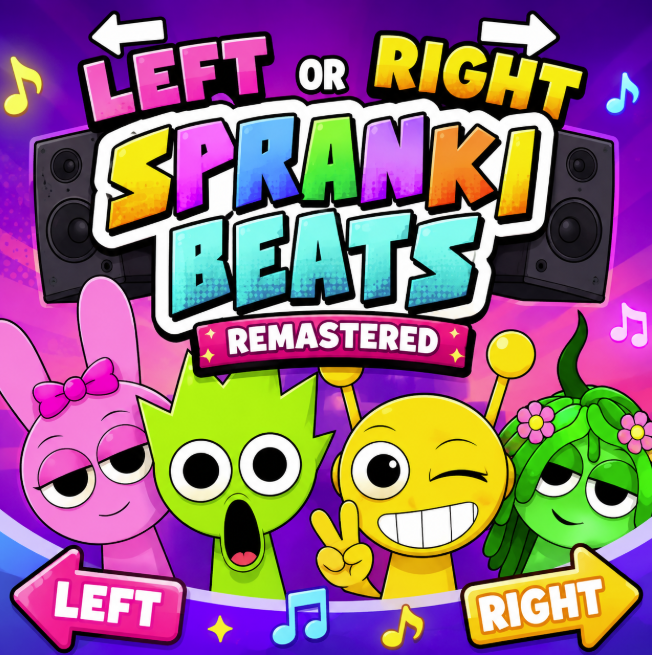
Gauche ou Droite Spranki Beats
Nouveaux jeux recommandés















Left or Right: Spranki Beats is an inventive rhythm game that distills the genre to its purest essence: a binary choice between two directions, synchronized with a musical pulse. Unlike conventional titles that demand complex button combinations, scrolling note highways, or dense visual feedback, this game strips the experience down to a single, elegant question—will your next move be left or right? The result is an engaging hybrid of reflex testing, pattern recognition, and auditory perception, delivering the thrill of a rhythm action game without entangled controls or overloaded interfaces.
The premise is simple: as music plays, the game issues prompts indicating which side of the screen to select. In its most basic form, the player must choose the correct side to match the cue. Timed with the accompanying track, each attempt maintains rhythmic consistency and builds a sensorial link between what you hear and what you do. The design ethos is accessibility—anyone can pick it up and understand the core loop within seconds—but the escalating speed and dynamic patterns ensure that seasoned players are not left with a shallow experience. Each track contains its own embedded rhythm signature, requiring the player to internalize the beat and predict the next prompt. The later tracks and advanced modes demand superior reactions, rhythmic intuition, and the ability to remain composed under tempo pressure. With a clear, intuitive user interface, visually unambiguous signals, and a compulsion loop that roars within minutes, Left or Right: Spranki Beats is a title that respects both newcomers and hardcore leaners within the niche, becoming an instant recommendation to rhythm game enthusiasts looking for a fresh twist on reflex-based gaming.
To get the most out of Left or Right: Spranki Beats, implement the following pratiche suggestions handed down from rhythm veterans:
Left or Right: Spranki Beats is an engaging meta-rhythm game that combines stark minimalism with robust depth. It honors the core principles of rhythm gameplay—practicing timing, memorization, and anticipation, and it wraps them in a simple two-digit access. For pros, more advanced modes provide a true benchmark of their reflexes, and for new players the onset and tutorials are a welcoming introduction. The real joyhere is in that small moment when the beat and your choice align flawlessly. So pick a side, focus, and let the music guide you.
Now check if we include all sections. "Précautions/Tips" spelling? We must use exactly "Precautions/Tips". In the summary, "How to Play" etc. We'll adjust if header case.
Also, the content mentions "rythm" but we should use correct "rhythm". Our article is in English.
We need about 1000 words. Let's count our draft. It's quite long; I'm not sure exact. I'll write more concise summary perhaps to balance. Let's estimate: Summary around 250 words, How to Play ~200, Key Features ~150, Tips ~300, closing ~100? Total ~1000. Good.
Now produce Markdown with headers as required. Ensure no extra preambles.
Let's final### Summary
Left or Right: Spranki Beats is an inventive rhythm game that distills the genre to its purest essence: a binary choice between two sides, synchronized with a musical pulse. Unlike conventional rhythm titles that rely on dense note highways, complex button combinations, or scrolling sliders, this game strips away all extraneous systems and leaves only the fundamental challenge—do you choose left or right, and can you do it exactly on the beat? The result is a seamless hybrid of timing, pattern recognition, and auditory intuition that offers a refreshingly accessible entry point for newcomers while still providing a substantial test for seasoned players.
The core premise is elegantly simple: prompts appear on screen indicating a left or right position, and the player must select the corresponding side in tune with the rhythm of a given track. Each track is built around its own rhythmic structure, requiring the player to internalize temporal spacing and anticipate when the next cue will arrive. The early tracks act as a gentle tutorial, encouraging players to grasp the basic flow. As the player advances, the speed increases, the patterns become more irregular, and the greater accuracy becomes mandatory. What sets this title apart, aside from its purity, is the speed at which it escalates—within the first hour, the game transitions from a casual listen-and-tap pastime to a high-stakes test of auditory processing and micro-decision accuracy. The vibe is intuitive for novices but deeply rewarding for those wanting to measure rhythm. Ultimately, Left or Right: Spranki Beats strips away all noise and entrusts you with a core primal wonder: can you be on the beat?
When you step into the game, you are greeted by a clean interface with a minimal selection of songs. Begin with an easier track to become comfortable with the rhythm and control. The playable is incredibly straightforward: during the song, you will see cues appear that guide you to choose the left or right side. Your task is to press the corresponding button or touch the appropriate area just as the beat hits. The crucial element is not how quickly you react, but how accurately you land each selection in tempo. Instead of smashing the input as fast as possible, you must listen to the beat and "slot" your move inside the groove.
Each song uses directional sounds, visual flashes, or pan effects to inform which side to pick. The base mode combines visual arrows and musical accents. A slow, steady tempo helps teach the fundaments; later songs feature more complex offbeat patterns that will break your anticipation. To play well, you need to develop both your peripheral vision and your sense of pulse. One useful method is to mentally "silence" the visual cue and rely on the rhythmic grooves for your hints. This is especially important because the game features four distinct modes, each with a unique rule on the classic left/right selection:
Each mode has its own skill curve, and players can switch between them to train different aspects of perception. Use the early tracks as pure training; do not rush to hardest difficulty, as you need to build your internal beatmap.
Successful play is not just about how quick you click—others have to be careful about the whole rhythm experience. Here are several tips to improve performance and avoid common pitfalls:
To sum up, remember: precision over raw speed, solid hearing, spatial awareness, and clear mental maps. Left or Right : Spranki Beats is a celebration of minimal groove. The player is invited to enter a musical loop where their input becomes the beat. It's the whole what – feel of sensorial gratification and sound added. That's the summit to master: not just be able to choose, but to choose in complete humanity to tune.
A: Left Or Right Spranki Beats est un jeu rythmique qui allie des mélodies entraînantes, des réflexes rapides et des décisions directionnelles simples. Pendant que la musique joue, vous observez les indices à l'écran et choisissez le bon côté au moment précis.
A: L'objectif central est de choisir le côté gauche ou droit en fonction des indices affichés, en veillant à ce que votre sélection soit synchronisée avec le rythme musical.
A: Pas du tout. Il n'y a pas de schémas de contrôle complexes ; vos seules tâches sont d'écouter la bande-son, de garder un œil sur les indices et de choisir la bonne direction.
A: Absolument. Les mécanismes de base sont assez simples pour que les nouveaux joueurs les comprennent rapidement, et les pistes d'introduction sont spécialement conçues pour familiariser les joueurs avec le fonctionnement du jeu.
A: Oui, elle augmente. Le tempo des motifs s'accélère progressivement, et les pistes ultérieures exigent des réflexes plus rapides ainsi qu'un sens plus affiné du timing et du rythme.
A: Le jeu comprend quatre modes de jeu distincts. Selon le mode choisi, vous devrez peut-être répondre aux rythmes musicaux, réagir aux indices audio, suivre des indicateurs visuels ou vous adapter à des structures de motifs changeantes.
A: Chaque mode introduit sa propre variation sur la mécanique fondamentale de sélection gauche/droite, ce qui maintient l'expérience fraîche et engageante. Certains modes mettent l'accent sur le timing musical, d'autres sur les réactions basées sur le son, certains reposent sur des signaux visuels, et quelques-uns combinent ces éléments avec des motifs changeants.
A: Les débutants devraient commencer par une piste plus lente et se concentrer sur les indices à venir. Lorsque le jeu signale à gauche, déplacez-vous vers la gauche ; lorsqu'il signale à droite, déplacez-vous vers la droite. Visez à faire chaque mouvement exactement en rythme.
A: Si une séquence commence à sembler écrasante, prenez du recul mentalement et concentrez-vous sur la gestion d'un seul indice à la fois plutôt que d'essayer de traiter tout le motif d'un coup.
A: Un timing précis importe bien plus que la simple vitesse. Prêtez une attention particulière à la musique afin de pouvoir prédire quand le prochain choix directionnel apparaîtra et réagir en conséquence.
A: Gardez votre regard fixé près de la zone où les indices apparaissent, minimisez tout mouvement inutile de la main ou du corps, et rejouez régulièrement les pistes afin d'apprendre les motifs rythmiques courants et de réagir plus instinctivement.
A: Une fois que vous vous sentez à l'aise avec les motifs fondamentaux, défiez-vous en passant à des chansons plus rapides et à des modes plus exigeants qui poussent votre temps de réaction et votre précision rythmique.
A: La courbe d'apprentissage est à la fois agréable et satisfaisante, avec des contrôles simples faciles à apprendre, une variété de modes à explorer et des pistes qui deviennent progressivement plus difficiles pour vous garder stimulé.
A: Ce jeu convient parfaitement aux passionnés de rythme qui apprécient une touche créative sur la formule traditionnelle des jeux de rythme et qui aiment tester leur timing et leurs compétences de prise de décision.
En lançant Gauche ou Droite Spranki Beats, les joueurs se voient proposer une variété de pistes. Pour les nouveaux venus, il est conseillé de commencer par une piste plus simple afin de saisir le rythme de base et de comprendre comment les invites évoluent. Les mécanismes sont simples : des indices apparaissent, vous indiquant si vous devez choisir le côté gauche ou droit. Vous répondez ensuite en appuyant sur la touche correspondant à ce côté. Le timing est primordial : votre saisie doit s'aligner sur le rythme du beat, plutôt que de se fier uniquement à la mémorisation de l'ordre.
La phase initiale fonctionne comme un tutoriel interactif, introduisant progressivement plus d'invites et réglant le tempo. Les débutants doivent se concentrer sur la zone d'affichage et attendre que le signal visuel apparaisse. En même temps, écoutez la musique et essayez de synchroniser votre réponse avec le beat. Cliquer au hasard le plus vite possible réduira votre score ; le jeu pénalise les clics insouciants. Plutôt, la précision du timing est plus valorisée que la vitesse brute. Dans tous les modes, le principe de base reste constant : choisir gauche ou droite à chaque apparition d'un indice, mais la forme de cet indice peut varier considérablement.
Les quatre modes :
Gauche ou Droite (Classique) – C'est le mode de base. Les indices sont affichés sous forme de flèches ou de texte « GAUCHE » et « DROITE ». La musique et l'indicateur visuel arrivent en même temps, fournissant deux signaux simultanés qui aident à établir rapidement une connexion.
Mode sonore uniquement – Ici, tous les indices visuels directs sont supprimés. À la place, vous écoutez un signal audio unique, comme un son fortement orienté à gauche ou à droite, ou une note de musique émergeant d'un canal particulier. Votre tâche est d'identifier le côté de la source et de répondre sans délai. Ce mode aiguise vos compétences d'écoute et met au défi votre vitesse de réaction.
Mode d'invite visuelle – Ce mode supprime le guidage musical et repose uniquement sur des indicateurs visuels, comme un flash de couleur ou un objet se déplaçant d'un côté. Il nécessite un traitement presque subconscient, et la difficulté augmente à mesure que la vitesse s'accroît.
Mode de changement de motif – Ce mode combine des éléments des autres. Les signaux auditifs et visuels peuvent toujours être présents, mais le tournant crucial est que les règles peuvent changer pendant une piste—par exemple, vous pourriez soudainement devoir sélectionner le côté opposé, ou l'orientation gauche/droite pourrait être inversée. Les joueurs doivent constamment rester alertes face aux conditions évolutives.
Chaque mode conserve la simplicité apparente de choisir gauche ou droite, mais chacun change le niveau d'effort mental requis. Passer régulièrement de l'un à l'autre entraîne le cerveau à faire des distinctions nettes.