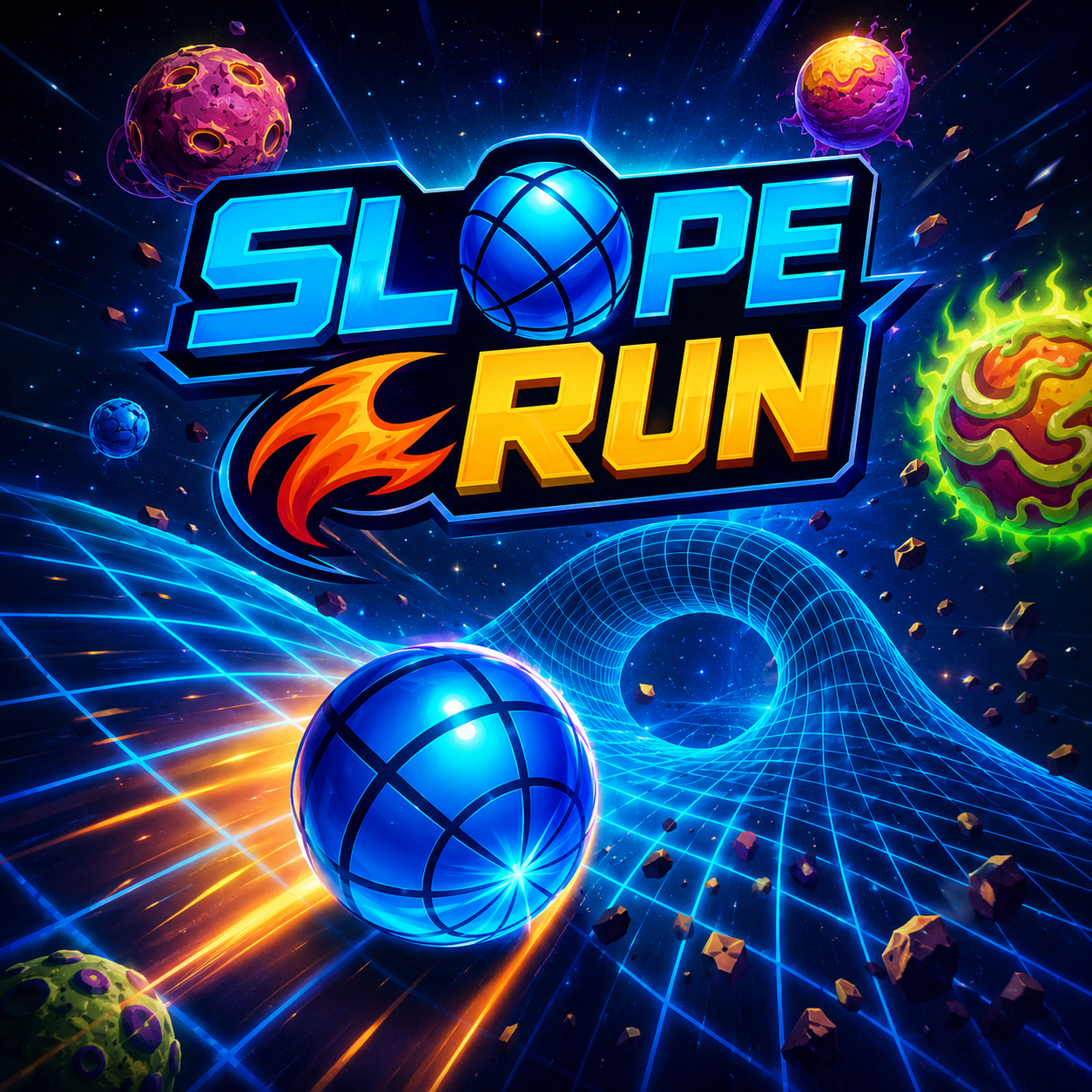
Slope Run
New Recommended Games











Slope Run is a fast-paced 3D endless runner that fuses precision platforming with a captivating sci-fi narrative. Set in a luminous cosmic tunnel, players control a futuristic ball—revealed to be an amnesiac astronaut—who must navigate a gauntlet of collapsing platforms, treacherous gaps, and spatial hazards to recover lost memories and conquer the galaxy. The game offers a dual-mode structure: a Level Mode with handcrafted stages that progressively unveil the story, and an Infinite Mode that tests endurance against an ever-accelerating tunnel. Designed for both casual pick-up-and-play sessions and hardcore reflex challenges, Slope Run rewards careful timing, spatial awareness, and consistent practice. Its sleek 3D visuals, responsive controls, and escalating difficulty curve create a compelling loop that keeps players returning for just one more run. With a straightforward control scheme accessible on both desktop and mobile, the title lowers the barrier to entry while raising the ceiling for mastery, making it a standout entry in the genre of minimalistic yet demanding endless runners.
zard or falling into the void instantly ends the run, forcing a restart. The difficulty ramps up as speed increases, demanding faster decision-making and more accurate jumps.
Game Modes
Objective and Progression
The primary objective is to reach the end of each level or survive as far as possible in Infinite Mode. Success in Level Mode unlocks subsequent stages and reveals the narrative fragments. In Infinite Mode, achievements are measured by distance and score, encouraging repeated attempts to refine technique.
1. Fluid 3D Endless Runner Gameplay
Slope Run employs a polished 3D engine that delivers smooth, high-frame-rate motion through vibrant, procedurally generated environments. The camera angle remains fixed behind the ball, providing clear visibility of upcoming obstacles and pathways, which is critical for planning moves ahead.
2. Dual-Mode Structure for Varied Challenge
The game respects different playstyles by offering both Level Mode (goal-oriented, story-driven) and Infinite Mode (pure survival and score chasing). This duality ensures that players seeking closure and those craving endless replayability both find satisfying content.
3. Responsive and Accessible Controls
Whether on a keyboard or a touchscreen, the controls require no complex combos or memorized sequences. The immediate feedback of jumps and strafes makes the game easy to pick up but difficult to master, a hallmark of great arcade-inspired design.
4. Gradual Difficulty Curve with Checkpoint System
In Level Mode, checkpoints prevent total frustration by letting players resume from a midway point after a failure. The difficulty escalates thoughtfully, introducing new hazards—such as collapsing platforms, narrow ramps, and sudden directional shifts—without overwhelming newcomers.
5. Sci-Fi Narrative Integration
Unlike many endless runners that focus solely on mechanics, Slope Run weaves a light narrative: the ball is a lost astronaut recovering memories. Each completed level unlocks a story snippet, giving players a sense of progression beyond mere score accumulation. This narrative layer adds emotional investment to the otherwise mechanical challenge.
6. High Replayability and Speed Feedback
As the ball’s speed increases, the feel of momentum becomes tangible. Successfully threading a narrow gap or landing a perfect jump at high speed delivers a visceral sense of accomplishment. Infinite Mode’s escalating pace ensures that no two runs feel identical, pushing players to adapt continuously.
7. Clean Visual and Audio Design
The game’s neon aesthetic against dark space backgrounds minimizes visual clutter, allowing players to read obstacles at a glance. The soundtrack and sound effects—whooshing tunnels, electronic stings upon failure, and satisfying chimes for checkpoints—reinforce the futuristic atmosphere without distracting from the gameplay.
1. Master Centering and Anticipation
Keep the ball near the center of the tunnel whenever possible. This neutral position maximizes reaction time to obstacles appearing from either side. If you drift too far left or right, you may be forced into an awkward jump or an unavoidable collision. Look several “blocks” ahead—not just at the immediate obstacle—to plan your route across broken platforms and around barriers.
2. Avoid Button Mashing and Frantic Tapping
Jumping repeatedly or tapping left/right in rapid succession often leads to mistimed moves. Instead, treat each action as deliberate. For jumps over gaps, wait until the ball is at the edge of the platform before pressing the jump button. For lane changes, make one smooth movement rather than two or three corrections. Calm precision trumps panicked speed.
3. Learn the Patterns of Different Obstacle Types
The game introduces various hazards: fixed spikes, moving walls, disappearing paths, and gap sequences. Pay attention to timing cues. For example, a disappearing platform usually follows a rhythmic pattern—observe it for one cycle before committing. Memorizing the sequence of a tricky section in Level Mode is not cheating; it is smart practice.
4. Use Checkpoints Wisely
In Level Mode, reaching a checkpoint saves progress only for that specific attempt. If you fail after a checkpoint, you restart from that point, not from the beginning. Use this to break the level into manageable segments and focus on mastering one section at a time before moving on.
5. Tune Your Device for Responsiveness
On mobile devices, ensure your screen is clean and that you are not covering the button area with your palm. On desktop, a wired or low-latency keyboard is recommended. Turn off any background applications that might cause input lag or frame drops.
6. Embrace Failure as a Learning Tool
In both modes, each death is a data point. Ask yourself: Did I jump too early? Did I steer too late? Did I misjudge the gap? Over time, you will internalize the game’s physics—the exact jump height, the travel speed, the distance needed to clear a platform. Patience and repetition are the keys to consistent performance.
7. Manage Fatigue for Longer Sessions
Infinite Mode, in particular, can become mentally exhausting as the speed climbs. If you find your reactions slowing down or your focus waning after several attempts, take a short break. Stretching your hands and eyes will improve your performance when you return.
8. Disable Notifications to Avoid Interruption
A sudden phone notification or pop‑up message can break concentration and cause an accidental death. Enable Do Not Disturb mode on mobile devices or use fullscreen mode on desktop to eliminate distractions.
Q: What is Slope Run?
A: Slope Run is a high-speed 3D endless runner that merges precise platform navigation with an exciting science fiction journey. Players guide a futuristic orb traveling through luminous space corridors, dodging hazardous obstacles while uncovering enigmatic planets.
Q: What is the storyline behind Slope Run?
A: The orb is actually an astronaut who lost all memories after a crash and must traverse the galaxy to regain them. As you progress through stages, you will explore vibrant planets that gradually unveil fragments of the astronaut’s forgotten past.
Q: Which game modes are offered in Slope Run?
A: Slope Run includes two game modes: Level Mode, which features carefully designed stages with escalating difficulty and checkpoints that advance the narrative; and Infinite Mode, where the goal is to survive as long as possible while the tunnel grows faster and increasingly erratic.
Q: How do I control the ball on a desktop computer?
A: On a desktop, press the Up Arrow to leap, the Left Arrow to shift left, and the Right Arrow to shift right.
Q: How do I control the ball on a mobile device?
A: On a mobile device, tap the Up button to leap, and tap the Left and Right buttons to move sideways.
Q: What occurs if I fall into space or fail to land on a platform?
A: Falling into the void or missing a platform instantly ends your attempt, motivating you to refine your abilities with each try.
Q: Does the difficulty increase as I continue playing?
A: Yes, your movement speed gradually rises, making every accurate jump and well-timed maneuver more demanding. In Infinite Mode, the tunnel accelerates and becomes more unpredictable.
Q: What types of obstacles will I face in the game?
A: You will encounter vanishing platforms, broken routes, wide chasms, tight corridors, and dangerous space hazards that require swift reflexes.
Q: What advice is recommended for achieving success in Slope Run?
A: Keep to the center for quicker reactions, time your jumps carefully rather than hopping repeatedly, scan ahead to map your path across broken platforms, execute smooth movements, and practice tough sections.
Q: Does Level Mode include story progression?
A: Yes, Level Mode consists of handcrafted stages with distinct layouts, growing difficulty, and checkpoints that slowly disclose the tale of the astronaut’s lost memories.
Q: What does Infinite Mode involve in Slope Run?
A: Infinite Mode eliminates any endpoint, pushing you to sustain your survival for as long as possible while aiming for your longest distance and highest score.
Q: Are there games similar to Slope Run?
A: Yes, comparable titles include Speed Slope, Bowling Master, Slope Rider, and others such as A Small World Cup 2, RocketGoal.io, and Tap Road.
Q: Can I play Slope Run in fullscreen mode?
A: Yes, a "Full Screen" option is available to enjoy the game in fullscreen view.
Q: How can I report a bug or problem in the game?
A: You can click "Report a bug" and then choose the issue you encountered, such as "The game doesn't load," "The game is not working," "I lost my progress," "I saw something inappropriate," or other options, and submit it.
Q: Is it possible to share Slope Run with friends?
A: Yes, there is a "SHARE WITH YOUR FRIENDS" feature that allows you to copy a link to distribute the game.
Q: What genre does Slope Run belong to?
A: Slope Run is an adventure endless runner that incorporates obstacle evasion, 3D visuals, and ball-based controls.
The fundamental gameplay of Slope Run is deceptively straightforward: the sphere moves forward automatically, and the participant must direct it safely across a constantly shifting obstacle course set in the vacuum of space. Achieving success relies entirely on instantaneous reactions and exact control timing.
Controls
On a computer, press the Up Arrow key to leap, the Left Arrow key to shift horizontally to the left, and the Right Arrow key to shift horizontally to the right. On handheld devices, virtual buttons—marked Up, Left, and Right—take the place of keyboard commands. The controls are highly responsive and intentionally lack gradual acceleration or momentum, so each action is instantaneous and foreseeable.
Basic Movement and Survival
The sphere navigates a twisting, neon-illuminated pathway interspersed with gaps, vanishing platforms, and narrow edges. Participants must steer to the left or right to evade obstacles that jut out from the walls and floor, and leap to cross chasms or land on unstable surfaces. Making contact with any hazard results in immediate failure.