Flowball
Nowe polecane gry


















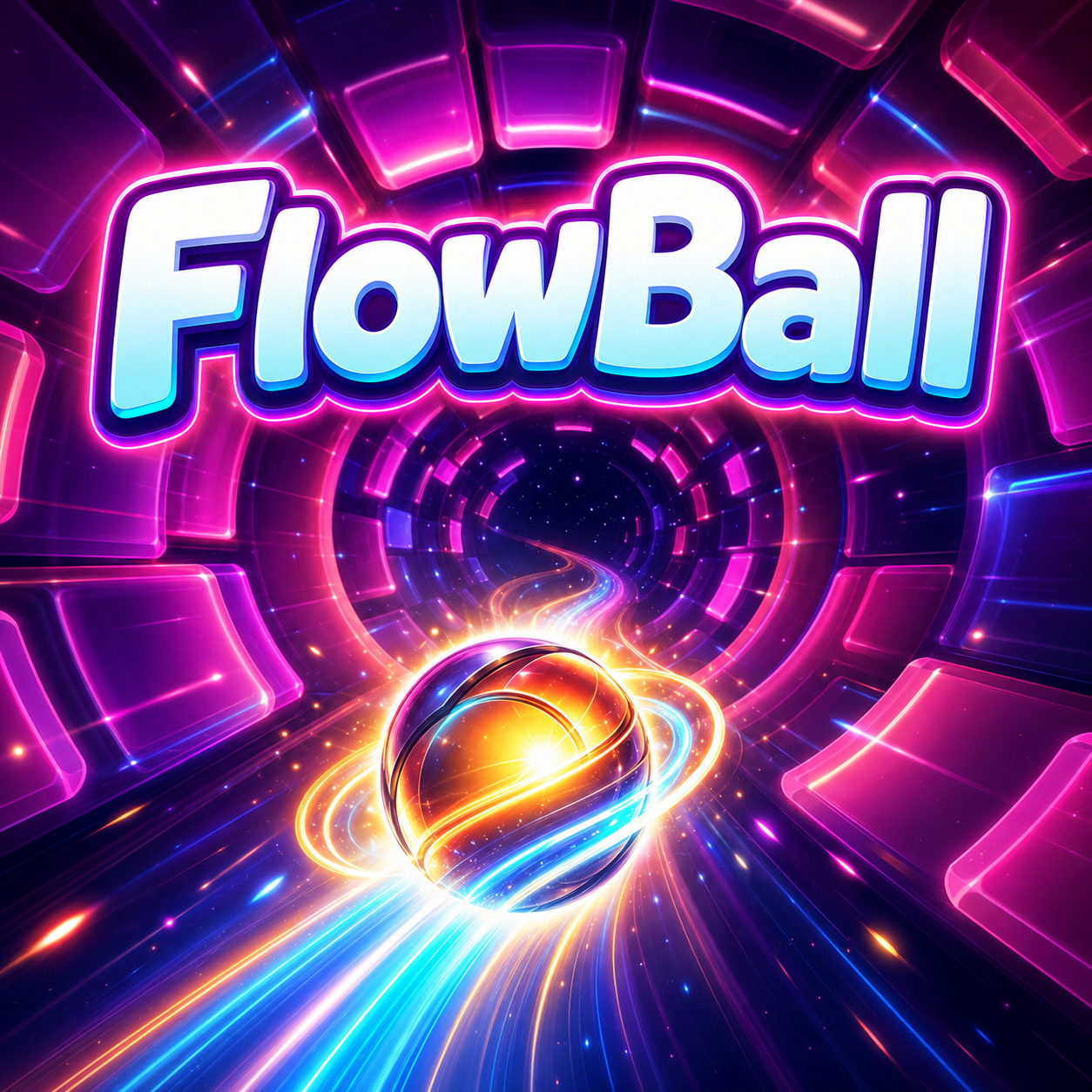
FlowBall is a fast-paced 3D arcade experience that distills the essence of reflex-based gaming into a single, elegant challenge. You control a luminous ball racing through an endless, twisting tunnel suspended in space. The ball moves forward automatically, which means your primary responsibility is not acceleration but survival. Every run presents a continuous stream of hazards: traps that block the path, gaps that split the tunnel, meteors that streak across your trajectory, and glowing dots that tempt you with score bonuses. The core loop is deceptively simple: steer, flip, collect, and survive for as long as possible. However, the game steadily raises the stakes by increasing speed and compressing the distance between obstacles. What begins as a calm drift through a neon void quickly becomes a high-intensity test of spatial awareness, timing, and decision-making under pressure. For players who enjoy mastering a single, well-honed mechanic, FlowBall offers an addictive balance of accessibility and depth. It is easy to understand within seconds, yet genuinely difficult to master, rewarding those who learn to read the tunnel ahead and commit to every movement with precision. The game’s visual clarity and responsive controls make it a satisfying choice for both casual sessions and extended score-chasing attempts.
zards. Since the ball advances automatically, you do not need to manage speed or acceleration. Instead, all attention should be directed toward the path ahead and the placement of your ball relative to incoming threats.
The game’s most distinctive mechanic is the ability to flip the tunnel. By pressing the Spacebar, you can invert the entire tunnel, changing gravity and causing the ball to fall onto the opposite surface. This is not just a visual trick; it is essential for survival. Some gaps span the entire width of the tunnel, leaving no lateral route around them. In these situations, flipping the tunnel allows the ball to transfer to a new surface and bypass the obstacle. The key to success is timing. Flip too early, and you may land directly in front of another trap. Flip too late, and the ball will slip through the gap before gravity can take hold. A skilled player watches the sequence of obstacles rather than reacting to each one individually, treating the tunnel as a continuous rhythm of surfaces and hazards.
On supported desktop versions, mouse controls are available as an alternative. The game allows you to steer using the mouse, which can offer finer control for players who prefer pointer-based movement. Regardless of input method, the underlying strategy remains the same: maintain a steady line, minimize unnecessary movement, and reserve flips for moments when they are absolutely required.
Bonuses are woven into the layout of each run. Glowing dots appear along the tunnel and provide varied rewards. White dots add 10 points and serve as the basic scoring currency. Blue dots add 500 points and attract nearby white dots, allowing you to chain collections efficiently. Green dots add 750 points and grant temporary protection from obstacles, acting as a brief shield during dangerous stretches. Red dots add 1,000 points but reverse your steering controls for a short period. This introduces a risk-reward layer to every decision. A red dot can dramatically accelerate your score, but it may also disrupt your control at the worst possible moment. You must decide whether the bonus is worth the danger, especially when the dot appears near a tight turn, a narrow gap, or a cluster of meteors.
FlowBall stands out for its tight integration of simple controls and increasingly complex spatial challenges. The tunnel itself is a dynamic environment, not just a static backdrop. It twists, turns, and flips upside down, forcing you to constantly reorient yourself. The visual style is clean and futuristic, with a glowing ball and a neon-lit tunnel that clearly communicates depth and distance. The lack of clutter allows you to focus entirely on the gameplay.
The game is endless, meaning there is no final level. Instead, the challenge is measured by how far you can progress and how high your score can climb. This structure encourages repeated attempts, as each run offers a new arrangement of obstacles and bonuses. The increasing speed creates a natural difficulty curve that keeps the adrenaline flowing without requiring any manual adjustment.
The bonus system adds strategic depth. While collecting dots is generally beneficial, the red dot’s control reversal introduces a genuine trade-off. The blue dot’s attraction effect encourages route planning, as you can position yourself to sweep up nearby white dots efficiently. The green dot’s temporary shield provides a safety net, but it is not unlimited, so you cannot rely on it entirely. These elements combine to create a gameplay loop where scoring and survival are closely intertwined. A player who simply dodges everything will earn a modest score, while a player who actively pursues risky bonuses may either achieve a spectacular run or crash out quickly.
Additionally, the game supports multiple input methods, including keyboard and mouse. This flexibility allows players to choose the control scheme that feels most natural. The user interface is minimal, with no complex menus or cumbersome tutorials. You can start a run immediately and learn through direct feedback. For game enthusiasts who appreciate mastery through practice, FlowBall provides a clean, satisfying environment to refine your reflexes.
To perform consistently in FlowBall, you need more than fast reflexes; you need a deliberate approach to movement and planning. First, always keep your eyes on the far portion of the tunnel. The ball moves quickly, and obstacles become visible only briefly before you reach them. By scanning ahead, you can identify hazards early and decide whether steering or flipping is the better response. Avoid oversteering. Small, precise adjustments are safer than large swings, because wild lateral movement increases the chance of colliding with an obstacle that appears suddenly.
When you encounter a gap that spans the full tunnel, resist the urge to flip immediately. Assess what lies on the opposite surface before committing. If the next obstacle is already directly below, a well-timed flip may land you in a better position, but a poorly timed one can be fatal. The optimal moment to flip is when the gap is close, allowing the ball to cross over without falling through, but not so close that you have no time to adjust after landing. Practice reading the rhythm of gaps and flips, as this is often the difference between a short run and a long one.
Exercise caution with red dots. Their high score value is tempting, but the control reversal can cause you to steer directly into an obstacle. If a red dot appears in open, safe space, it may be worth grabbing. If it appears near a narrow corridor, a cluster of meteors, or immediately before a gap, it is usually smarter to let it pass. Survival takes priority over points in the early part of a run, because a longer run naturally generates more scoring opportunities.
The green dot’s shield is precious. Use it to pass through a section you are unsure about, but do not become complacent. The shield only protects against obstacles for a limited duration, and it does not prevent you from falling through a gap. Treat the shield as a tool to mitigate mistakes, not as an excuse to ignore the path ahead. Similarly, the blue dot’s attraction effect is most valuable when you can align it with a row of white dots. Instead of chasing every white dot individually, wait for a blue dot and then move into a position that allows the attraction to sweep up multiple points at once. This is the most efficient way to build a high score without exposing yourself to unnecessary danger.
Finally, pay attention to how speed changes your timing. A flip that feels safe at low speed can be disastrous at high speed, because the ball covers more distance in the same amount of time. As the tunnel accelerates, you must start your maneuvers earlier. Do not rely on muscle memory alone; continuously recalibrate your sense of timing as the run progresses. By staying calm, planning your route, and respecting the risks of high-value bonuses, you can extend your run and push your score to new heights. FlowBall rewards patience as much as speed, and the players who succeed are those who know when to act and when to hold back.
P: Co to jest Flowball?
O: Flowball to energiczne trójwymiarowe arcade, w którym gracze kierują świecącą kulą przez nieskończony tunel kosmiczny.
P: Jak porusza się piłka w Flowball?
O: Piłka sama porusza się do przodu, a Ty musisz unikać przeszkód, przeskakiwać nad otworami, omijać latające skały i zbierać cenne świecące punkty.
P: Jaki jest główny cel w Flowball?
O: Podstawowym celem jest przetrwanie jak najdłużej, zbieranie punktów i unikanie zagrożeń, aby osiągnąć jak najwyższy wynik.
P: Jak sterować piłką w Flowball?
O: Naciśnij klawisze A lub D, albo lewą lub prawą strzałkę, aby kierować piłkę w bok.
P: Jak odwrócić tunel w Flowball?
O: Naciśnij spację, aby odwrócić tunel, zmieniając grawitację i przenosząc piłkę na inną powierzchnię.
P: Dlaczego odmierzanie czasu jest ważne przy odwracaniu tunelu?
O: Przedwczesne odwrócenie może umieścić piłkę tuż przed innym zagrożeniem, a zbyt późne sprawić, że wpadnie w otwór. Kluczowe jest dokładne wyczucie czasu, by przeżyć.
P: Jakie są efekty białych kropek w Flowball?
O: Białe kropki dają 10 punktów każda.
P: Jakie są efekty niebieskich kropek w Flowball?
O: Niebieskie kropki dają 500 punktów i przyciągają pobliskie białe kropki.
P: Jakie są efekty zielonych kropek w Flowball?
O: Zielone kropki dają 750 punktów i zapewniają tymczasową tarczę przed przeszkodami.
P: Jakie są efekty czerwonych kropek w Flowball?
O: Czerwone kropki dodają 1000 punktów, ale odwracają twoje komendy sterowania, co czyni ruch ryzykownym w wąskich miejscach.
P: Czy zawsze warto zbierać wysoko punktowane kropki, np. czerwone?
O: Nie, kropki dające dużo punktów nie zawsze są korzystne. Odwrócone sterowanie z czerwonych kropek może być niebezpieczne, dlatego lepiej skupić się na przetrwaniu, gdy taki bonus pojawi się w pobliżu krawędzi lub przeszkody.
P: Jak wzrasta trudność w Flowball?
O: Tunel staje się coraz trudniejszy, gdy prędkość rośnie, a przeszkody pojawiają się gęściej.
P: Jakie umiejętności są potrzebne do zdobycia wysokiego wyniku w Flowball?
O: Niezbędne są szybkie refleksy, precyzyjne ustawienie i sprytne wykorzystanie grawitacji.
P: Czy są alternatywne sposoby sterowania oprócz klawiatury?
O: Tak, w kompatybilnych wersjach na komputer można używać myszy jako alternatywnej metody sterowania.
P: Jak podzielić się Flowball z przyjaciółmi?
O: Dostępna jest opcja „Podziel się z przyjaciółmi”, która kopiuje link do gry.
P: Jak zgłosić błąd w Flowball?
O: Naciśnij przycisk „Zgłoś błąd”, wybierz kategorię problemu (np. gra się nie ładuje, gra nie działa, brak postępu itp.), a następnie wyślij zgłoszenie.
P: Co się stanie, jeśli odwrócisz tunel zbyt wcześnie lub zbyt późno?
O: Odwrócenie przed czasem może umieścić kulę tuż przed inną pułapką, a zbyt późne może sprawić, że wpadnie w otwór. Kluczowe jest dokładne wyczucie czasu.
Podstawowy ruch w FlowBall jest prosty. Możesz użyć klawiszy A i D lub klawiszy strzałek w lewo i w prawo, aby poprowadzić piłkę na boki po podłodze tunelu. Ten ruch boczny służy jako główny sposób unikania większości przeszkód, zbierania punktów i ustawiania się na nadchodzące zagrożenia.