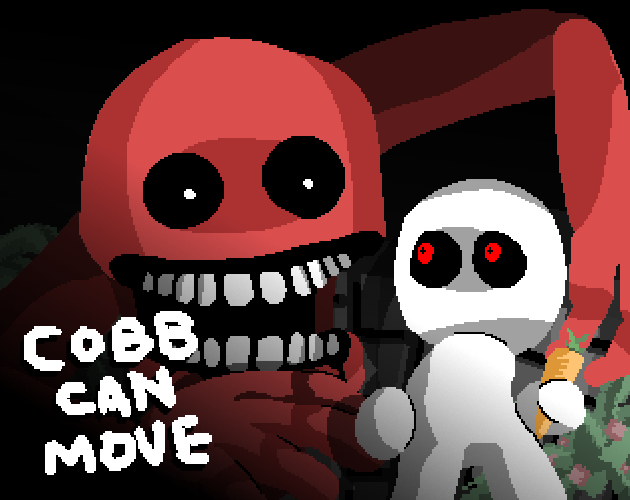
Cobb Can Move
New Recommended Games



















COBB CAN MOVE is a survival horror game that subverts genre conventions by introducing dynamically shifting rules. Developed for Major Jam 7 under the theme "Wild," this title presents players with a compact, high-intensity experience where the fundamental logic of gameplay can change without warning. In a concise play session typically lasting only a few minutes, players must navigate procedurally generated levels while managing the tension of an unpredictable threat known as Cobb. The game strips away extraneous mechanics to focus on core survival elements: observation, adaptation, and quick decision-making. With a top-down pixel art aesthetic and atmospheric sound design, COBB CAN MOVE delivers a distilled horror experience that emphasizes psychological unease over jump scares. Its procedural generation ensures that no two runs are identical, providing replayability within a deliberately short runtime.
Dynamic Rule System: The central pillar of the game is its ever-changing rule set. Each level introduces a new modifier that alters how the player interacts with the environment and the enemy. This mechanic ensures that the game remains challenging and unpredictable even after multiple playthroughs.
Procedural Generation: Levels are procedurally generated, meaning the layout, item placement, and enemy behavior patterns vary with each new game. This feature prevents memorization of static paths and reinforces the need for real-time adaptation.
Pixel Art Visuals: The game employs a distinctive pixel art style that evokes classic survival horror titles while maintaining a modern, clean aesthetic. The visual design is intentionally restrained, using a limited color palette to create a tense and oppressive atmosphere.
Atmospheric Audio: Sound design and music are crafted to enhance the horror experience. Ambient noises, subtle audio cues, and a dynamic soundtrack work together to build suspense and signal changes in the game state, such as when Cobb is near or when a rule shift occurs.
Short but Intense Sessions: Designed for quick play sessions, COBB CAN MOVE respects the player’s time by delivering a concentrated dose of survival horror. The average session lasts only a few minutes, making it ideal for players who want a fast, impactful experience.
Control Flexibility: The game supports both keyboard and gamepad inputs, allowing players to choose their preferred control method for precise movement and reaction.
Pay Close Attention to Rule Changes: The game does not always announce rule shifts explicitly. A change in background color, enemy behavior, or available actions may signal a new constraint. Developing observational habits is essential for survival.
Expect Repeated Failure: The learning curve is steep, and the game is designed to be punishing. Each death provides valuable information about the current rule set. Approach each attempt as a learning opportunity rather than a setback.
Manage Your Movement Carefully: In many scenarios, reckless movement can attract Cobb or trigger an unfavorable rule. Sometimes the safest action is to remain still and assess the environment before committing to a direction.
Use Audio Cues: The soundtrack and sound effects are not merely atmospheric; they often indicate proximity to danger or a change in the game’s logic. Playing with headphones can provide a significant advantage.
Be Prepared for Contextual Controls: Because the rules change, the function of certain inputs may vary between levels. A button that performed one action in a previous level may perform a different action or become entirely useless. Always test your controls after a rule shift.
Embrace the Ephemeral Nature: The game is intentionally brief and does not feature a lengthy narrative or progression system. It is designed to be replayed in short bursts. Treat each run as a self-contained challenge rather than a persistent campaign.
Check for Updates: The developers have released multiple updates since the initial launch, addressing balance issues and adding refinements. Keeping the game updated ensures access to the most polished version of the experience.
A: No, there’s no built-in way to reset progress. Using a different browser will give you a fresh save, or you can edit the localStorage save directly if you know how.
A: Make sure you click on the game window before pressing the arrow keys. The game may not register inputs if it isn’t focused.
A: In the current version, Cobb just tanks the rocks. The next update will make the rocks stun him temporarily.
A: No, the game is not designed for mobile. It uses keyboard and gamepad inputs and runs on HTML5 and Windows only.
A: That is the game’s title and a core mechanic: the rules of the survival horror experience change as you play.
A: The game was created by abho (art, programming, game design) with programming help from Vystel and Federico, SFX by frost, music by Jimmy, and playtesting by Imslandar and giohappy.
A: The game was made with Construct, Aseprite, Audacity, and FL Studio.
A: It is available as an HTML5 browser game and as a Windows download.
A: The average session is only a few minutes.
A: It is a singleplayer experience.
A: It is a survival horror game with tags: 2D, Endless, Horror, Pixel Art, Procedural Generation, Singleplayer, Survival Horror, Top-Down.
A: No, the content was created without any generative AI.
A: It is released, with the latest update (v1.6) published 19 hours ago.
A: The developer has not announced additional levels, but the game receives regular updates (v1.1 to v1.6).
A: Many players describe it as scary and tense, with a creepy atmosphere and difficult challenges.
A: Yes, it supports any gamepad in addition to keyboard inputs.
The core gameplay loop of COBB CAN MOVE is deceptively simple. Players control a character navigating a top-down 2D environment. The primary objective is to survive each level by avoiding or outsmarting the entity named Cobb. The player can move in four directions using standard keyboard inputs or a gamepad. However, the defining twist lies in the game's central premise: the rules change.
Upon starting a level, the game presents a specific rule or set of rules that govern player and enemy behavior. For example, a rule might dictate that the player can only move when Cobb is not looking, or that certain actions attract or repel the entity. The player must quickly identify the current rule and adapt their strategy accordingly. As the player progresses, these rules shift between levels, demanding constant vigilance and flexibility. The game provides minimal explicit instruction, requiring players to learn through experimentation and careful observation. Defeat is typically swift and punishing, resetting the run and encouraging the player to learn from their mistakes.